Choking Relief for Infants and Children: What CPR Classes Cover
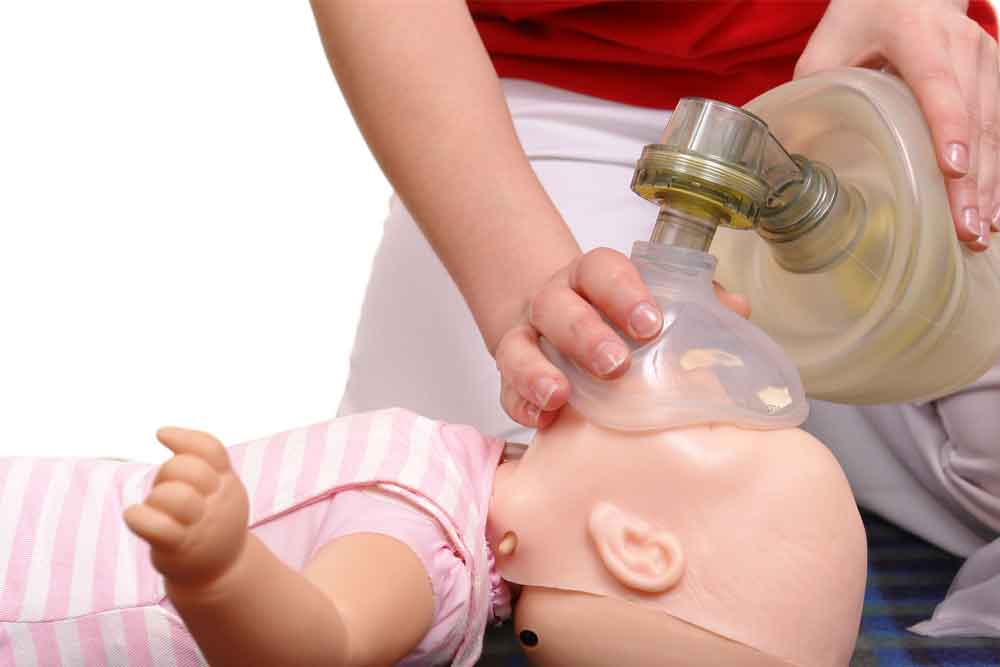
A choking incident involving a child or baby is one of the most terrifying emergencies a parent, teacher, or caregiver can face. It happens silently, quickly, and often without any warning. Whether a toddler swallows a small toy or an infant struggles with a piece of food, the window to act is incredibly small.
Knowing exactly how to respond can mean the difference between a momentary scare and a devastating tragedy. Unfortunately, many well-meaning bystanders rely on outdated advice or panic-driven instincts. This is why formal, hands-on training is an absolute necessity.
In a certified American Heart Association (AHA) class, you learn evidence-based choking relief for infants and children. The techniques taught differ significantly from adult procedures due to a child’s delicate anatomy. By learning these age-specific protocols, you build the muscle memory required to act decisively under extreme pressure.
In this comprehensive guide, we break down exactly what to expect from your pediatric CPR training. We cover how to recognize severe airway obstructions, the distinct methods used for babies versus older children, and why in-person practice is unmatched. Here is what you will learn when you sign up for a high-quality CPR and First Aid class.
Why Pediatric Choking Requires Specialized Training
Babies and young children are naturally curious, frequently using their mouths to explore the world around them. This developmental stage makes them highly susceptible to airway obstructions. According to pediatric safety data, items like grapes, hot dogs, coins, and small toy parts are frequent culprits.
However, a child is not just a miniature adult. Their airways are narrower, their bones are still developing, and their internal organs are far more exposed. Applying adult choking techniques to an infant can cause severe, life-threatening internal damage.
This is where formal training bridges the gap between panic and effective action. A certified CPR instructor teaches you how to modify your physical force. You learn the anatomical reasons why specific thrusts are used and how to adapt your body mechanics to fit the size of the victim.
Recognizing the Signs of a Severe Airway Obstruction
Before intervening physically, you must first assess the severity of the choking incident. CPR classes emphasize the critical difference between a mild airway obstruction and a severe one. If a child is coughing forcefully or crying loudly, they still have air exchange. In these mild cases, instructors teach you to monitor the child closely and encourage them to keep coughing, rather than interfering.
A severe obstruction, on the other hand, requires immediate physical intervention. The hallmark sign of severe choking is sudden silence. The infant or child cannot cry, speak, or cough effectively.
Other unmistakable red flags include a high-pitched squeaking noise when trying to breathe, clutching the throat (the universal choking sign), and a bluish tint to the lips or skin. When you recognize these signs, you must step in immediately. Your AHA BLS CPR certification course will run through varied scenarios so you can identify these visual cues in seconds.
How Do CPR Classes Teach Choking Relief for Infants?
Infants, defined in medical training as children under one year of age, require a highly specialized approach. Because their abdominal organs are fragile and unprotected by a fully developed rib cage, you should never use abdominal thrusts on a baby. Doing so can cause catastrophic internal injuries.
Instead, CPR classes teach a strict sequence of back slaps and chest thrusts. First, you learn how to safely support the infant’s head and jaw while resting their body face-down along your forearm. Gravity plays a vital role here, so the baby’s head must be angled lower than their chest.
Once the infant is properly positioned, you deliver five forceful back slaps between the shoulder blades using the heel of your free hand. If the object does not dislodge, you carefully flip the baby over, keeping their head and neck supported. You then administer five chest thrusts using two fingers placed directly on the lower half of the breastbone.
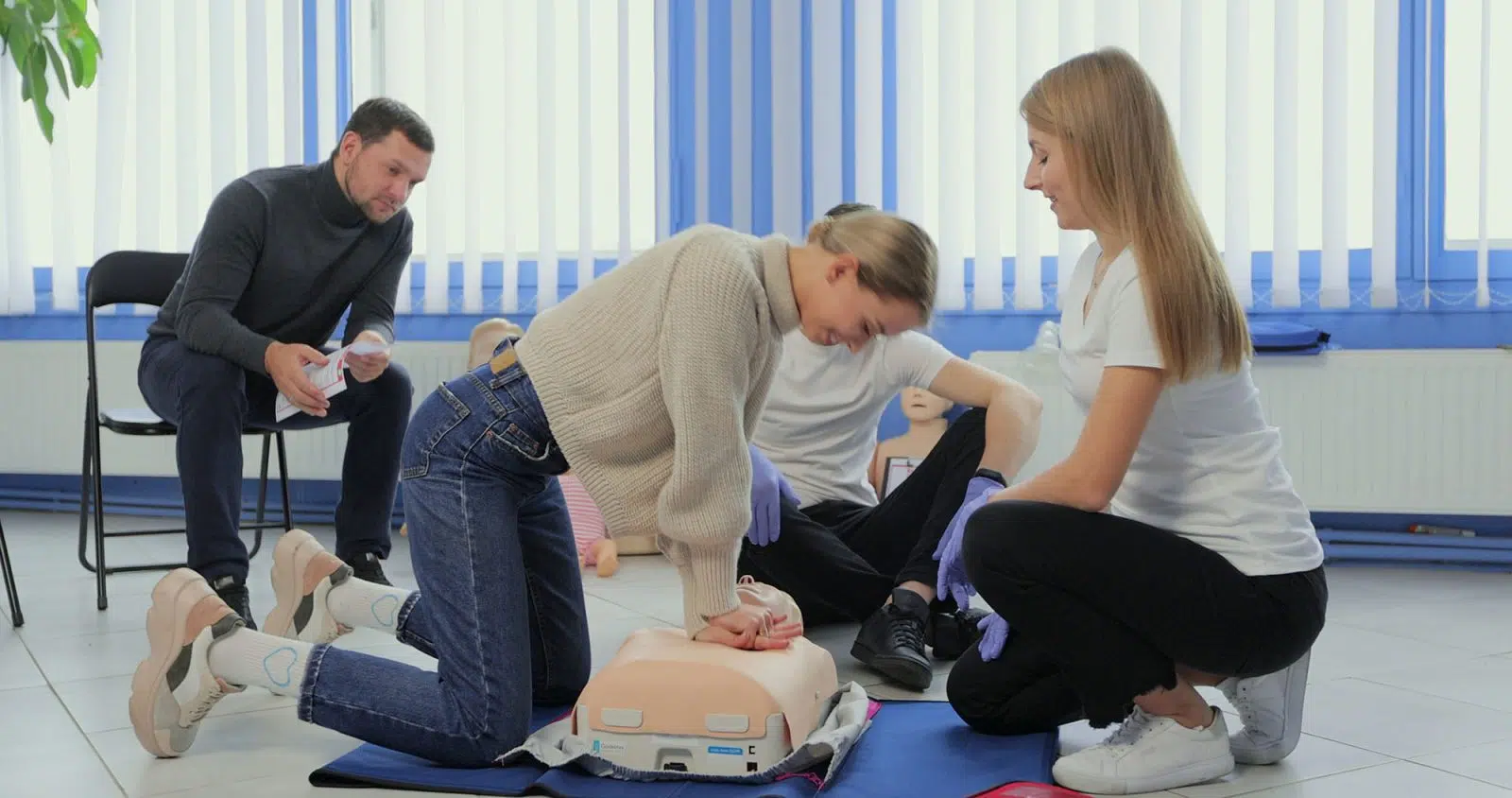
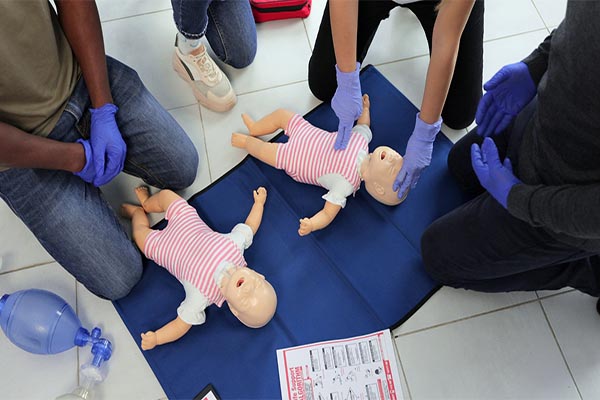
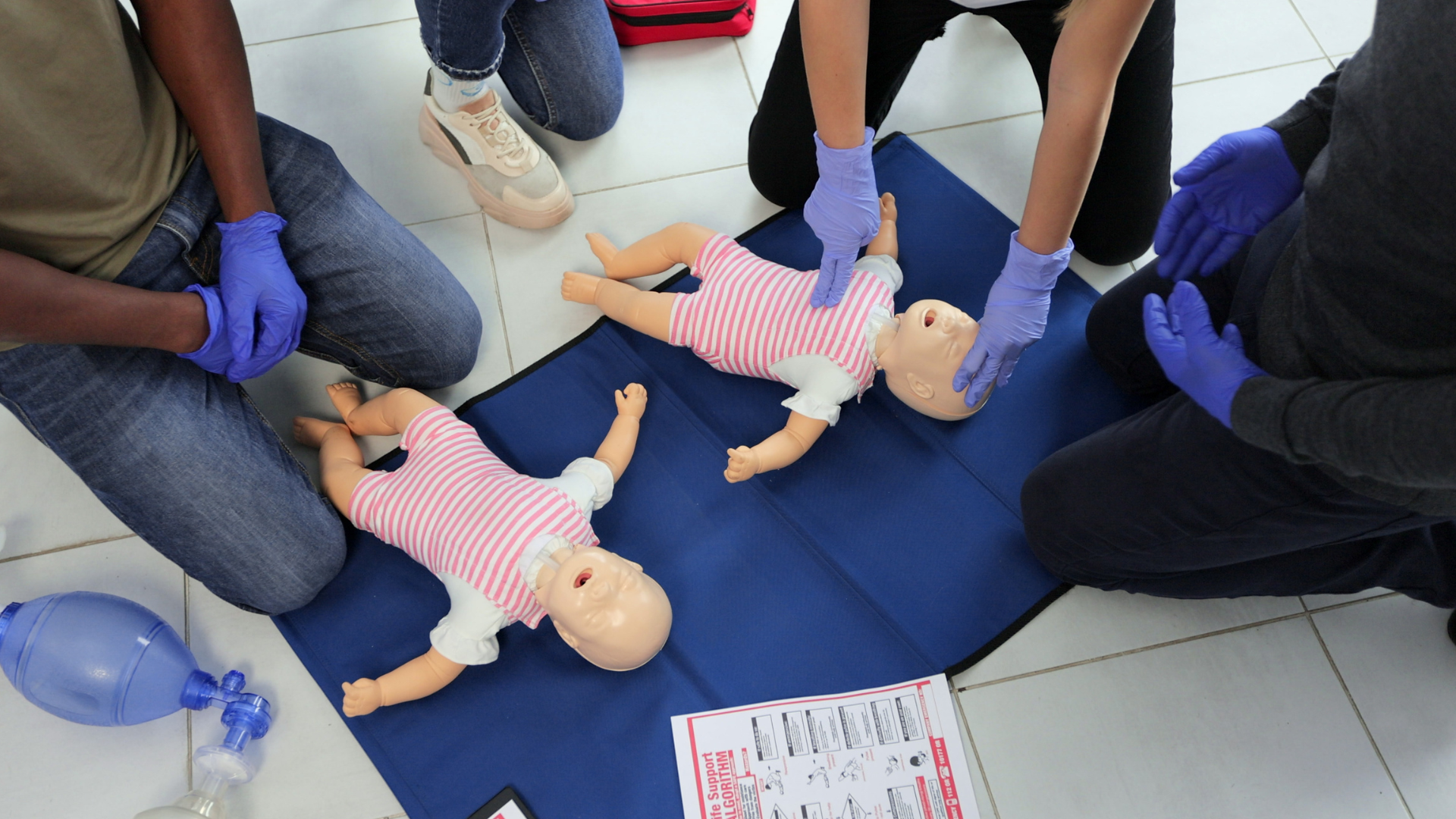
This 5-and-5 cycle continues until the object is expelled or the infant becomes unresponsive. During an in-person class, you practice this exact sequence on realistic infant manikins. This tactile experience ensures you know exactly how much force to apply in a real-world crisis.
Performing Choking Relief for Children: What You Will Learn
For children older than one year, the approach changes. The protocol closely mirrors adult choking relief but requires crucial modifications for size and height. The primary technique taught for this age group is the abdominal thrust, widely known as the Heimlich maneuver.
In your certification class, you learn how to correctly position yourself behind the choking child. If the child is small, you may need to kneel behind them to align your arms properly. Kneeling ensures your thrusts go inward and upward, effectively forcing air out of the lungs to push the obstruction free.
Proper hand placement is essential to avoid breaking ribs or damaging organs. Instructors teach you to make a fist with one hand, place it just above the child’s navel, and grasp it with your other hand. You then deliver quick, upward thrusts as if you are trying to lift the child off their feet.
You must continue these thrusts until the airway is clear. Hands-on practice allows you to refine your grip, stance, and angle so you can deliver abdominal thrusts efficiently and without hesitation.
The Hidden Danger: Why You Should Never Do a Blind Finger Sweep
One of the most valuable lessons taught in any American Heart Association CPR class is what not to do. Human instinct often tells panicked parents to stick their fingers into a choking child’s mouth to pull the object out. This is known as a “blind finger sweep,” and it is incredibly dangerous.
Instructors explicitly warn against this practice because it usually makes the situation worse. A blind finger sweep often pushes the foreign object deeper into the narrow pediatric airway. This turns a partial blockage into a complete, fatal obstruction.
Instead, training emphasizes that you should only attempt to remove an object if you can clearly see it and easily pinch it out with your fingers. Otherwise, rely entirely on back slaps, chest thrusts, or abdominal thrusts to do the work safely.
Transitioning to CPR: What Happens If the Child Becomes Unresponsive?
A critical component of choking relief for infants and children is knowing how to escalate your care. If the obstruction cannot be cleared and the child is deprived of oxygen, they will eventually lose consciousness. At this terrifying moment, choking relief protocols transition directly into Cardiopulmonary Resuscitation (CPR).
Your instructor will guide you through this seamless transition. The moment an infant or child goes limp, you must carefully lower them to a firm, flat surface and shout for someone to call 911. You then immediately begin chest compressions.
The chest compressions used in CPR serve a dual purpose here: they circulate oxygenated blood to the brain and can also create enough internal pressure to pop the obstructing object loose. Every time you open the airway to give rescue breaths during CPR, you are taught to briefly look in the mouth for the dislodged object.
By mastering both choking relief and high-quality CPR in a single training session, you become fully equipped to handle a respiratory emergency from the first sign of distress through a full cardiac arrest.
The Value of In-Person AHA BLS Certification
While you can read countless articles or watch online videos about choking relief, nothing replaces hands-on training. In a high-stress emergency, your brain relies heavily on muscle memory. Reading about proper hand placement is fundamentally different from physically performing it on a training manikin.
Local organizations like CPR Classes Near Me offer specialized AHA BLS CPR and First Aid training that guarantees you learn these skills correctly. With highly trained instructors providing immediate, personalized feedback, you learn exactly how deep to compress a chest and how hard to deliver a back slap.
Furthermore, obtaining an official AHA eCard ensures that your certification is globally accepted by employers in healthcare, education, childcare, and beyond. You leave the classroom on the exact same day not just with a piece of paper, but with the genuine confidence that you can save a life.
Conclusion
Choking is a silent, sudden emergency that leaves zero time for second-guessing. By understanding the distinct protocols for choking relief for infants and children, you can take immediate, effective action. From delivering life-saving back slaps to a fragile baby, to properly executing abdominal thrusts on a toddler, these skills are invaluable for any parent, teacher, or medical professional.
Don’t wait until an emergency strikes to figure out what to do. Protect the ones you love and the community you serve by getting fully certified.
Ready to master these life-saving skills? Contact CPR Classes Near Me today to register for your local AHA BLS CPR certification class and gain the confidence you need to handle any emergency.
Frequently Asked Questions
How is choking relief for infants different from adults?
Infants have fragile bodies and underdeveloped rib cages, making adult techniques dangerous. Instead of abdominal thrusts, infant choking relief relies on a sequence of five back slaps followed by five chest thrusts. The infant’s head must also be carefully supported and angled downward during the procedure.
Can I use the Heimlich maneuver on a baby?
No, you should never use the Heimlich maneuver (abdominal thrusts) on a baby under one year old. Applying deep pressure to an infant’s abdomen can cause severe damage to their internal organs. Always use back slaps and chest thrusts for infants.
What should I do if a choking child becomes unconscious?
If a choking infant or child loses consciousness, immediately lower them to a firm, flat surface and shout for help or call 911. You must then begin standard CPR, starting with chest compressions. Remember to look inside the mouth for the obstructing object every time you open the airway to give rescue breaths.
How long does a CPR certification class take?
An in-person AHA BLS CPR certification class typically takes about 3.5 to 4 hours to complete. During this time, you will watch required instructional videos, complete hands-on skills practice, and take a brief evaluation to earn your same-day certification card.
Do CPR classes teach you how to use an AED on children?
Yes, a comprehensive CPR class covers the use of an Automated External Defibrillator (AED) for victims of all ages. You will learn how to apply pediatric AED pads and adjust the device settings specifically for infants and small children.
What are the most common choking hazards for infants?
Infants and toddlers frequently choke on small, round foods and household objects. Common hazards include grapes, hot dog slices, popcorn, coins, marbles, and small parts broken off from toys.
Is hands-on CPR training better than online certification?
Yes, hands-on training is vastly superior and often required by employers. In-person classes allow you to practice physical techniques on manikins, building vital muscle memory, while instructors provide real-time feedback to ensure you are applying the correct amount of force.