Infant CPR Training for Daycare Staff: The Complete Guide to Workplace Safety and Compliance
Why is CPR Important for Infants

Every single day, parents hand over their most precious gift—their infants—to the trusted care of daycare staff. In early childhood environments, safety is not merely a policy checkbox; it is an active, moment-by-moment commitment. When a medical emergency occurs, such as an unexpected airway obstruction or sudden respiratory distress, infant CPR training for daycare staff transforms panic into life-saving action.

This comprehensive guide breaks down everything childcare directors, teachers, and staff members must know about infant cardiopulmonary resuscitation (CPR) and pediatric first aid. You will learn key anatomical differences, step-by-step emergency protocols, state licensing mandates, and how to secure official American Heart Association (AHA) credentials for your team.

Why is Infant CPR Training Essential for Daycare Staff?

Infants under 12 months old possess delicate physiological systems that react rapidly to oxygen deprivation. Unlike adults, whose cardiac events usually stem from underlying heart disease, infants typically experience cardiac arrest secondary to respiratory failure or airway obstruction.

Without immediate intervention, irreversible brain damage can occur within 4 to 6 minutes of oxygen loss. Having staff members who are confident in infant CPR creates an immediate safety net that keeps oxygenated blood flowing to vital organs until emergency medical personnel arrive.

State childcare licensing agencies nationwide strictly enforce CPR standards. Maintaining fully certified personnel on-site during all operational hours ensures legal compliance while reassuring parents that their children are protected by trained professionals.

How Does Infant CPR Differ From Adult and Child CPR?

Performing CPR on an infant requires distinct adjustments in hand placement, compression depth, and rescue breathing force. Applying adult-level force to an infant’s small chest can cause severe internal injuries.

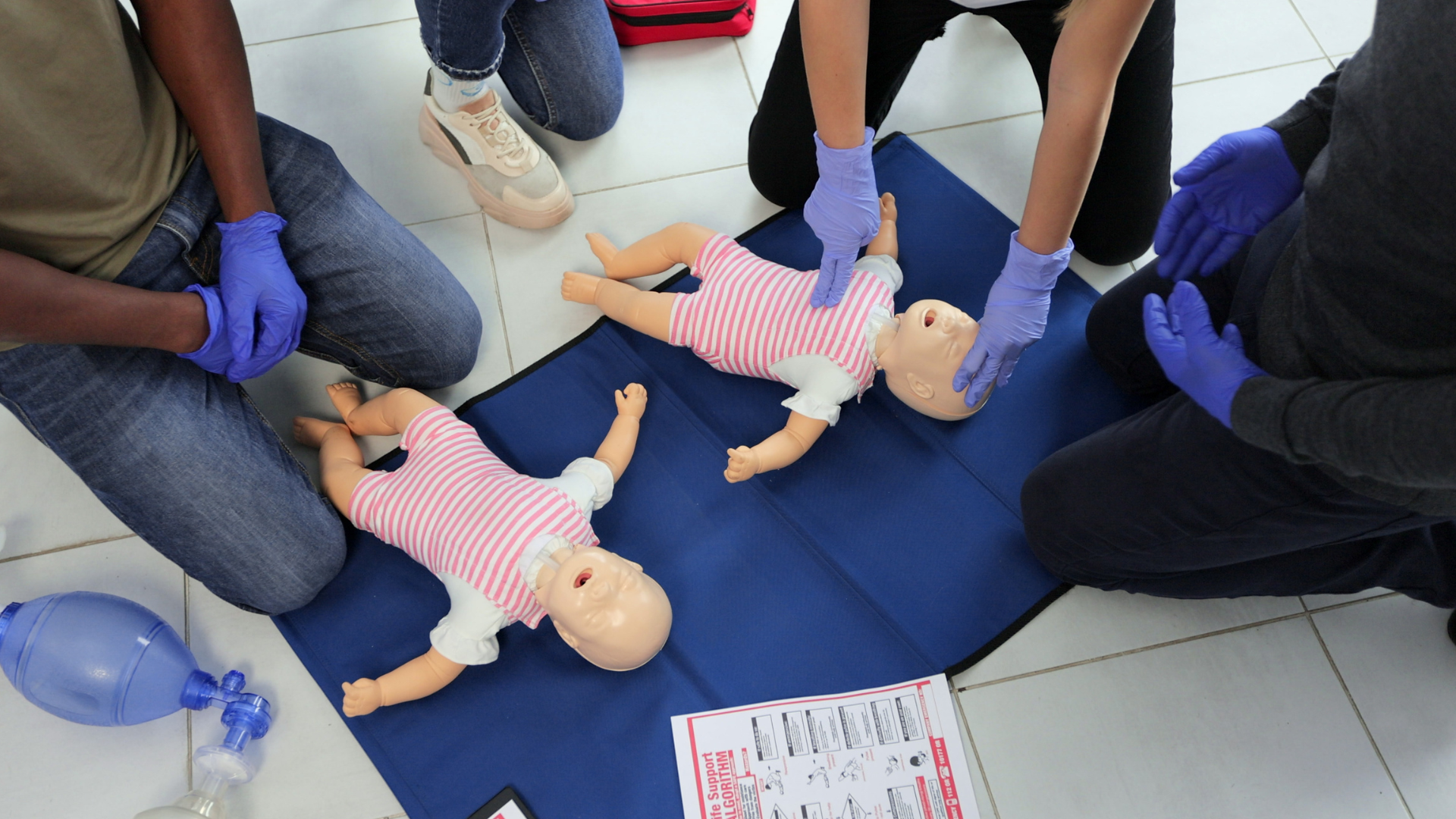
When delivering compressions to an infant under one year old, a single rescuer uses just two fingers placed in the center of the chest, just below the nipple line. If two trained rescuers are present, they use the two-thumb encircling hands technique. The depth of chest compressions for an infant is about 1.5 inches (4 cm), whereas child compressions are about 2 inches (5 cm), and adult compressions are at least 2 inches (5 to 6 cm).

The rate of chest compressions remains uniform across all ages at 100 to 120 compressions per minute. However, the compression-to-breath ratio changes based on rescuer numbers for pediatric victims. For infants and children, a single rescuer uses a 30:2 ratio, but two rescuers switch to a 15:2 ratio to maximize oxygenation. For adults, the ratio remains 30:2 regardless of the number of rescuers.

When giving rescue breaths to an infant, open the airway gently without overextending the neck and cover both the baby’s nose and mouth with your mouth to create a tight seal. For children and adults, pinch the nose closed and cover only the mouth.

What Are the Key Steps in the Infant CPR Protocol?

When an infant becomes unresponsive in a daycare setting, executing the American Heart Association Chain of Survival saves crucial seconds. Follow these sequential steps carefully.

1. Check Responsiveness and Call for Help

Tap the bottom of the infant’s foot gently and shout their name. If the infant does not move or make a sound, shout for nearby staff members to call 911 and retrieve an Automated External Defibrillator (AED). If you are alone, perform 2 minutes of CPR (5 cycles) before calling 911 yourself.

2. Check Breathing and Pulse

Look at the infant’s chest for 5 to 10 seconds to detect normal breathing. Check for a brachial pulse along the inner upper arm between the elbow and shoulder. If there is no pulse or if the pulse is below 60 beats per minute with signs of poor perfusion, begin chest compressions immediately.

3. Deliver High-Quality Chest Compressions

Place the infant on a firm, flat surface such as a table or the floor. Position two fingers in the center of the chest, just below the nipple line. Press down approximately 1.5 inches deep at a steady rhythm of 100 to 120 compressions per minute, allowing the chest to recoil fully between pushes.

4. Provide Gentle Rescue Breaths

Open the airway using a gentle head-tilt, chin-lift technique—be careful not to tilt the head back too far, as an infant’s trachea is flexible and can pinch shut. Cover both the baby’s nose and mouth with your mouth, delivering two soft breaths just until you see the chest gently rise.

5. Attach and Use an AED

If an AED is available, turn it on immediately. Apply pediatric attenuator pads (or adult pads if pediatric pads are unavailable, ensuring they do not touch each other by placing one on the center chest and one on the back). Follow the device’s voice prompts to deliver a shock if advised, then resume compressions instantly.

How Should Daycare Workers Handle Infant Choking Emergencies?

Choking is one of the leading causes of accidental injury in infant childcare settings. Small toys, food items, or loose craft supplies can easily block an infant’s tiny airway.

Recognizing the signs of silent choking—where the baby cannot cry, cough, or breathe, and their skin or lips turn blue—is vital. Do NOT perform abdominal thrusts (the Heimlich maneuver) on an infant. Instead, follow the standard infant choking protocol:

  1. Position the Infant Face-Down: Hold the infant face-down along your forearm, resting your arm on your thigh for support. Support the infant’s head and jaw with your hand, keeping the head lower than the chest.
  2. Deliver 5 Back Slaps: Give 5 distinct, firm back slaps between the infant’s shoulder blades using the heel of your hand.
  3. Turn the Infant Face-Up: Flip the infant face-up onto your opposite forearm, keeping the head lower than the trunk.
  4. Deliver 5 Chest Thrusts: Place two fingers on the lower half of the breastbone and deliver 5 quick chest thrusts (about 1.5 inches deep).
  5. Repeat Until Cleared or Unresponsive: Continue alternating 5 back slaps and 5 chest thrusts until the object is expelled. If the infant becomes unresponsive, lower them to a hard surface and begin CPR compressions immediately, looking inside the mouth for the object before giving breaths.

What Licensing Requirements Apply to Daycare CPR Certification?

State departments of family and protective services enforce strict CPR compliance rules for early education facilities. While exact standards vary slightly by state, almost all jurisdictions require the following basic benchmarks:

  • 100% On-Site Coverage: At least one staff member with current infant and child CPR/First Aid certification must be present in the building and on field trips at all times.
  • Hands-On Practice Component: Fully online CPR courses without a live skills evaluation are almost universally rejected by state licensing inspectors and OSHA.
  • Two-Year Renewal Cycle: CPR credentials must be renewed every two years through an approved training curriculum.
  • Combined CPR and First Aid: Daycare employees typically require combined training covering infant/child CPR, AED operation, pediatric asthma response, allergic reaction management (EpiPen use), and basic wound care.

Investing in high-quality infant CPR training for daycare staff prevents costly licensing fines, lowers insurance premiums, and builds unshakeable confidence among your staff members.

Why Choose CPR Classes Near Me for Your Daycare Center?

When managing a busy early childhood facility, scheduling high-quality training should be straightforward and stress-free. CPR Classes Near Me provides elite, employer-accepted American Heart Association (AHA) training tailored specifically to daycare centers and educational staff.

Here is why daycare directors and individual educators trust our training programs:

  • Official AHA Credentials: Receive authentic American Heart Association certification eCards that meet all OSHA, state childcare licensing, and healthcare employer standards.
  • Same-Day eCard Delivery: No waiting weeks for your card in the mail. Your AHA eCard is issued electronically on the very day you complete your class.
  • Flexible On-Site Group Training: Our experienced instructors bring professional infant manikins, AED trainers, and course materials directly to your daycare facility, or your team can attend convenient local classes.
  • Affordable, Transparent Pricing: Individual AHA CPR classes start at just $64.95, while combined CPR and First Aid courses are available for $84.95.
  • Hands-On Learning Environment: We combine expert video instruction with interactive skills practice, ensuring every staff member gains real confidence in chest compressions and choking relief.

Summary of Key Takeaways

  1. Infants require specialized techniques: Always use 2 fingers or 2 thumbs for chest compressions to a depth of 1.5 inches, avoiding excessive force.
  2. Respiratory causes dominate: Most infant cardiac arrests stem from breathing trouble or choking, making rescue breathing and airway clearance essential.
  3. No Heimlich for infants: Use 5 back slaps alternating with 5 chest thrusts for conscious choking infants; never perform abdominal thrusts.
  4. Hands-on certification is required: Online-only cards do not meet state licensing or OSHA guidelines for daycare facilities.
  5. AHA eCards are issued same-day: Training with CPR Classes Near Me ensures your team earns official 2-year certification without delay.

Contact CPR Classes Near Me Today!

Protecting the infants in your care starts with hands-on, expert instruction. Whether you need individual certification or custom group training at your daycare center, CPR Classes Near Me is ready to assist you.

Don’t wait for an emergency to test your facility’s readiness. Contact CPR Classes Near Me today to schedule your American Heart Association Infant CPR and First Aid training!

Frequently Asked Questions

Can daycare staff take CPR training completely online?

No, state childcare licensing boards and OSHA do not accept 100% online CPR certifications. Effective infant CPR requires hands-on evaluation on infant manikins with an instructor. Courses offered by CPR Classes Near Me include all necessary in-person, hands-on practice to guarantee acceptance by regulatory bodies.

How often do daycare staff members need to renew infant CPR certification?

Infant CPR certification must be renewed every two years. Keeping credentials current ensures daycare staff stay updated on the latest American Heart Association guidelines and maintain peak muscle memory for emergency situations.

What is the compression-to-breath ratio for infant CPR in a daycare?

When a single daycare worker performs infant CPR, the compression-to-breath ratio is 30 chest compressions followed by 2 rescue breaths. If two trained rescuers are present, the AHA recommends a 15 compressions to 2 rescue breaths ratio to optimize oxygenation.

Are daycare facilities required to have pediatric AEDs on site?

While AED mandates vary by state, having an AED equipped with pediatric pads or a child key is highly recommended for all childcare centers. Automated External Defibrillators automatically analyze heart rhythms and deliver safe, scaled energy levels appropriate for infants and young children.

How long does an infant CPR and First Aid course take to complete?

A comprehensive American Heart Association CPR, AED, and First Aid class typically takes approximately 3.5 to 4 hours to complete. Upon finishing the hands-on practice and evaluation, participants receive their official AHA eCard on the same day.

What should a daycare staff member do if an infant stops breathing but still has a pulse?

If an infant is not breathing normally but has a clear pulse above 60 beats per minute, perform rescue breathing only. Give 1 gentle rescue breath every 2 to 3 seconds (20 to 30 breaths per minute) and recheck the pulse every 2 minutes.

Empowering Austin Educators: The Ultimate Guide to CPR Certification for Teachers, School Staff, and Childcare Workers

Hands performing chest compressions on a CPR training mannequin with AED pads attached.

Every single day, thousands of children step into classrooms, playgrounds, and childcare centers across the Austin metropolitan area. As educators, school administrators, and daycare providers, you are charged with more than just academic development; you are the primary guardians of student safety. When a medical emergency occurs, such as an unexpected playground injury, a severe allergic reaction, or sudden cardiac arrest, the response time of those on-site is the single most critical factor in saving a life.

For school staff and childcare providers, maintaining a valid, hands-on rescue credential is not merely a legal checkbox—it is a foundational pillar of community safety. If you are looking to secure or renew your credentials, getting your CPR Certification for Teachers in Austin through an official, American Heart Association (AHA) aligned program ensures you possess the real-world skills and state-approved validation to protect the young lives in your care.

What Are the Texas CPR Requirements for Teachers and School Staff?

The Texas Education Agency (TEA) maintains rigorous safety guidelines to ensure school personnel can respond effectively to sudden life-threatening crises. Under Texas Education Code Section 21.459, school districts are required to provide instruction to campuses on primary lifesaving techniques. Specifically, any staff member serving as a coach, physical education instructor, athletic trainer, cheerleading sponsor, or director of school-sponsored extracurricular activities must maintain active, hands-on CPR and Automated External Defibrillator (AED) certification.

Furthermore, individual school districts across Central Texas—including Austin ISD, Round Rock ISD, and Pflugerville ISD—frequently mandate that all classroom teachers, campus receptionists, and administrative support staff complete formal emergency training. Because a crisis can happen in a hallway or cafeteria just as easily as on a sports field, school systems prioritize staff-wide readiness. To satisfy these institutional and state-level directives, your certification course must feature an in-person, hands-on skills assessment using responsive training manikins.

Texas Education Code Compliance: Online-only courses that do not include physical, face-to-face skills practice do not meet the stringent standards set by Texas school districts and the TEA.

What Are the Texas Childcare CPR and First Aid Regulations?

If you operate or work within a licensed childcare center, preschool, or registered home daycare in the Lone Star State, your regulatory standards are established by Texas Health and Human Services (HHS) Child Care Regulation. State licensing standards dictate that all staff members who provide direct care to children must be certified in pediatric CPR and pediatric first aid.

This mandate is designed to address the distinct physiological differences between treating adults and saving infants or young children. Childcare facilities must have at least one employee on-site at all times who holds an active, hands-on certification. To ensure compliance during state inspections, your physical credential must clearly state that you have completed both CPR and First Aid training covering infants, children, and adults.

Why Do Teachers and Childcare Workers Need AHA BLS Certification?

While basic community CPR courses exist, the American Heart Association (AHA) Basic Life Support (BLS) course is the gold standard demanded by educational institutions and childcare licensing boards. The BLS designation proves you have mastered professional-grade rescue techniques.

A comprehensive AHA BLS course teaches you how to recognize the early signs of cardiac distress, perform high-quality chest compressions, deliver rescue breaths using barrier devices, quickly employ an AED, and relieve severe choking. By training to the professional BLS standard, you gain the muscle memory and mental clarity needed to manage an active emergency scene until Austin-Travis County EMS arrives on the scene.

How Does Pediatric CPR Differ from Adult CPR Techniques?

One of the most valuable aspects of classroom-based CPR training for educators is learning how to safely adjust rescue techniques based on the victim’s age. Performing adult-level compressions on a toddler or infant can cause severe physical harm, while using child-level pressure on an adult will fail to circulate oxygenated blood effectively.

Our targeted training programs highlight the critical mechanical and procedural differences across three distinct age groups:

  • Adult Resuscitation: Requires two-handed chest compressions pushed to a depth of at least 2 inches (but no more than 2.4 inches) at a steady tempo of 100 to 120 compressions per minute.
  • Child Resuscitation (1 year to puberty): Compressions are delivered using one or two hands, depending on the child’s physical size, pressing to a depth of approximately 2 inches.
  • Infant Resuscitation (under 1 year): Requires using two fingers or a two-thumb-encircling technique on the center of the chest, depressing the sternum exactly 1.5 inches to protect the infant’s fragile ribcage.

What Crucial Lifesaving Skills Are Covered in the Classroom?

A certified, in-person training session with CPR Classes Near Me Austin provides an interactive learning environment where you practice real-world rescue scenarios alongside experienced local professionals. The curriculum is comprehensive, leaving no gaps in your emergency preparedness.

Throughout your 3.7-hour training class, you will master the following essential skills:

  • High-Quality Chest Compressions: Mastering correct hand positioning, proper body mechanics to prevent fatigue, and ensuring full chest recoil between compressions.
  • Airway Management & Ventilation: Learning how to open a blocked airway using the head-tilt/chin-lift maneuver and delivering rescue breaths using pocket masks and bag-valve masks.
  • AED Operation: Understanding how to safely apply, power on, and follow the voice prompts of an Automated External Defibrillator on both child and adult victims.
  • Choking Relief (Foreign Body Airway Obstruction): Practicing abdominal thrusts (Heimlich maneuver) on standing child/adult manikins, and back blows combined with chest thrusts for choking infants.
  • First Aid Essentials: Managing severe bleeding, treating shock, handling allergic reactions (including EpiPen administration), and identifying signs of heat exhaustion or stroke.

Can Teachers and Daycare Staff Earn CPR Certification Online?

Many busy teachers and childcare workers are tempted by online-only programs that promise instant certification for low prices. However, these programs carry a massive hidden risk: they are almost universally rejected by Texas school districts, private academies, and state childcare licensing inspectors.

Because virtual courses cannot evaluate your physical technique, depth of compression, or speed of AED pad placement, they do not carry the backing of major safety organizations. The American Heart Association does not recognize online-only certificates without an in-person, hands-on skills session. Investing your time and money in a non-compliant online course often results in having to retake the entire training in person to satisfy employer mandates.

How Do On-Site Group CPR Training Classes Benefit School Campuses?

Coordinating individual schedules for dozens of teachers, aides, counselors, and cafeteria staff can be an administrative nightmare. To solve this logistical challenge, CPR Classes Near Me Austin specializes in on-site group CPR and First Aid training directly at your school campus, preschool, or daycare facility.

Our certified mobile instructors travel throughout the entire Austin metroplex—including Bastrop, Buda, Cedar Park, Georgetown, Hutto, Kyle, Lago Vista, Lakeway, Leander, Liberty Hill, Manor, Pflugerville, Round Rock, San Marcos, Taylor, and West Lake Hills. We bring all the necessary training materials, sterile manikins, and AED trainers directly to your facility. This on-site approach minimizes disruption to your academic calendar, ensures team cohesion during simulated emergencies, and allows your entire staff to earn their 2-year certifications simultaneously in a familiar setting.

What is the Step-by-Step Process to Secure Your Austin CPR eCard?

Securing your official American Heart Association credential through our Austin program is structured to be simple, fast, and stress-free.

1.Select Your Class Type:Under 5 Minutes.

Choose between the comprehensive AHA BLS CPR & AED Class ($64.95) or the combined CPR AED & First Aid Class ($84.95) based on your school’s or licensing board’s specific requirements.

2.Register Online or Book a Group:Under 5 Minutes.

Select a convenient date and time slot using our streamlined local booking calendar. For schools and daycare centers, call our Austin office to schedule a custom on-site group training session.

3.Attend the Hands-On Class:3.7 Hours.

Join our certified instructors at our comfortable Austin training site or host us at your location. You will watch instructional video modules, practice compressions on realistic manikins, and run through hands-on emergency scenarios.

4.Pass the Practical Skills Assessment:In-Class Evaluation.

Demonstrate your ability to deliver high-quality chest compressions, administer rescue breaths, and safely deploy an AED under the direct, supportive supervision of your instructor.

5.Receive Your Same-Day AHA eCard:Immediate Delivery.

Upon successful completion of the practical assessment, our team issues your official, OSHA-compliant American Heart Association eCard directly to your email inbox before you leave the classroom.

Ready to Secure Your Lifesaving Credentials Today?

Do not wait for an emergency to find out if you are truly prepared to save a life. Ensuring your school campus or childcare facility is safe, compliant, and ready to respond is one of the most important decisions you can make this school year.

Whether you are an individual classroom teacher needing to renew your biannual credentials or a school administrator looking to schedule a private, on-site certification day for your entire workforce, our local Austin team is ready to help.

Get certified with the experts. Contact CPR Classes Near Me today to enroll in an upcoming class or to request a customized group training quote for your school or childcare facility!

Frequently Asked Questions

How long is an Austin CPR certification valid for teachers?

An official American Heart Association (AHA) CPR and First Aid certification card is valid for exactly two years from the date of course completion. To maintain continuous compliance with Texas state laws and school district requirements, teachers and childcare workers must complete a renewal course before their current card expires.

Do online CPR classes meet Texas childcare licensing requirements?

No, online-only CPR certifications do not satisfy Texas Health and Human Services (HHS) licensing standards. Child Care Regulation mandates that all childcare staff complete hands-on, in-person training where a certified instructor evaluates physical compressions, rescue breathing, and AED pad placement on physical manikins.

How much do CPR and First Aid classes cost in Austin?

Individual AHA BLS CPR & AED classes in Austin are priced at a discounted rate of $64.95 (saving you $20 off the standard rate). The combined CPR, AED, and First Aid course is offered at a discounted rate of $84.95. Both course options include all hands-on training materials and same-day electronic card delivery.

Can school districts host private CPR classes on campus?

Yes. Our certified, local instructors regularly travel directly to school campuses, private academies, and daycare centers across the Austin area to perform on-site group training. We bring all necessary sterile manikins, AED units, and instructional media, letting your staff learn together in a familiar environment.

What happens if my CPR certification has already expired?

If your CPR certification has expired, you must enroll in a standard in-person certification course to regain your active status. The American Heart Association does not offer a grace period for expired cards; you must complete a full, standard BLS or CPR/First Aid training class to receive a valid new eCard.