BLS for Austin Nursing Students: What Local Programs Typically Expect
Preparing for nursing school is an incredibly exciting milestone, but it also comes with a mountain of clinical compliance paperwork. Between background checks, immunization records, and drug screens, there is one critical credential you cannot afford to overlook: your Basic Life Support (BLS) certification.
If you are enrolling in a nursing program in the Austin area, you will quickly find that keeping an active BLS card is a strict, non-negotiable prerequisite for stepping foot in any local hospital or clinical facility. However, not all CPR courses are created equal. Slipping up and taking the wrong class can cost you time, delay your clinical rotations, and force you to pay for training twice.
In this comprehensive guide, we will break down exactly why Austin nursing schools are so strict about their BLS requirements, what you will experience during your training, and how to ensure your certification meets every local institutional standard.
Why Do Austin Nursing Programs Specifically Require BLS Certification?
To understand why local schools are so rigid about this requirement, you have to look at the clinical environments where you will be trained. Major healthcare networks throughout Central Texas—such as Ascension Seton, St. David’s HealthCare, and Baylor Scott & White—partner with local colleges to host nursing students for clinical rotations.
These hospital networks maintain strict patient safety standards. They mandate that anyone providing direct patient care, including student nurses, must be fully certified to respond to cardiac and respiratory emergencies. Because hospitals require their staff to hold professional-level lifesaver credentials, nursing schools must enforce the exact same standard.
Furthermore, general CPR classes designed for the public do not cover the advanced team-based dynamics and clinical scenarios you will encounter in a hospital ward. Basic Life Support training ensures that when a code is called on your floor, you can seamlessly jump in to assist the healthcare team without hesitation.
Which BLS Certifying Body Is Accepted by Local Nursing Schools?
There is one golden rule when it comes to clinical compliance in Central Texas: Your BLS certification must be from the American Heart Association (AHA).
While there are other national organizations that teach emergency resuscitation, local nursing programs and major hospital systems almost exclusively recognize the AHA. In fact, submitting a non-AHA card to your clinical coordinator is one of the most common reasons students get turned away on compliance day.
When searching for a local course, always look for the official American Heart Association seal. Many online providers use misleading language to make their courses look official, but they lack the genuine credentials required by academic institutions. Taking a course through an authorized training site like CPR Classes Near Me Austin guarantees that your card will be fully accepted.
Can I Take My BLS Certification Online for Nursing School?
The short answer is no. Virtually all nursing programs in Austin reject 100% online CPR certifications.
Online-only courses are popular because they are fast and cheap, but they lack the physical, hands-on practice that is vital to mastering life-saving skills. You cannot learn the physical muscle memory of proper chest compression depth, or the spatial coordination of operating an Automated External Defibrillator (AED), simply by clicking through slides on a computer.
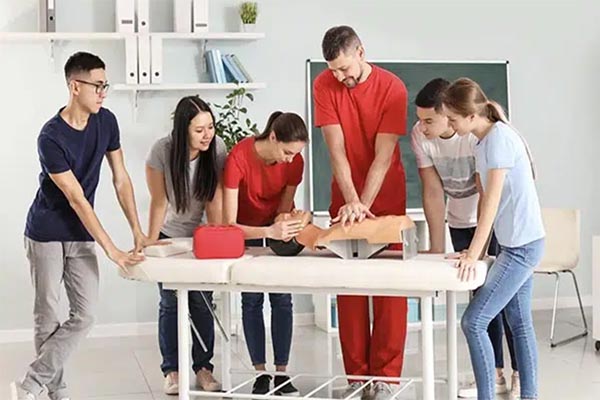
To meet school requirements, you must complete an in-person class where an authorized instructor physically evaluates your technique on adult, child, and infant manikins. If you prefer a hybrid approach, the AHA does allow “blended learning,” where you complete the cognitive portion online and then attend an in-person hands-on skills session. However, a fully in-person class remains the most straightforward way to get certified and ask real-time questions.
What Skills Will You Learn in an Austin BLS Class?
An AHA BLS course is designed to prepare you for high-stress, multi-rescuer medical emergencies. Unlike basic community CPR, this curriculum focuses on the clinical precision needed in professional healthcare environments.
During your session, you will dive deep into both the theory and physical application of the following core emergency skills:
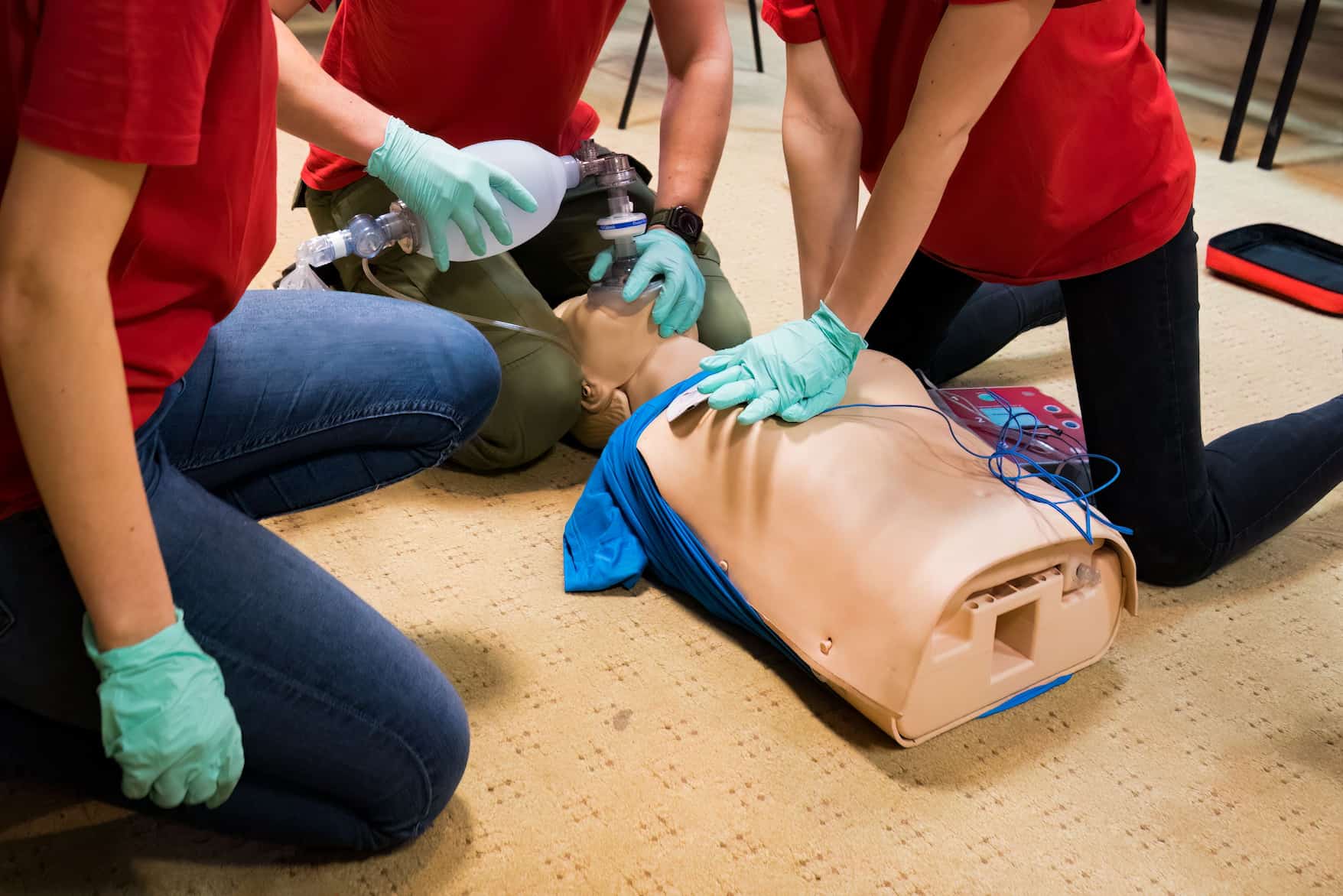
- High-Quality CPR: You will learn the exact compression depth (at least 2 inches for adults) and rate (100 to 120 compressions per minute) required to keep blood circulating to vital organs.
- Airway Management & Ventilation: Instructors will teach you how to use barrier devices and pocket masks, as well as how to coordinate two-rescuer bag-mask ventilation.
- AED Operation: You will practice safely setting up, powering, and delivering shocks using an Automated External Defibrillator on both adult and pediatric victims.
- Team Dynamics: Because hospital codes rely on seamless communication, you will practice multi-rescuer scenarios where you must delegate roles, communicate clearly, and minimize compression interruptions.
- Choking Relief: You will master the foreign-body airway obstruction clearance techniques for conscious and unconscious adults, children, and infants.
How Long Does the BLS Certification Class Take to Complete?
For busy nursing students juggling heavy study loads, time is incredibly precious. Fortunately, the in-person BLS class is designed to be highly efficient.
At authorized AHA training centers, the entire course—including the instructional video, hands-on practice, physical skills evaluation, and written exam—takes approximately 3.7 hours to complete. Because the curriculum is highly structured, there is no wasted time.
Once you successfully complete the course, you do not have to wait weeks for your physical card to arrive in the mail. Providers like CPR Classes Near Me Austin issue your official AHA BLS eCard digitally on the very same day. This means you can immediately download the PDF and upload it directly to your school’s clinical compliance portal.
How Often Must Nursing Students Renew Their BLS Certification?
Your AHA BLS certification is valid for exactly two years from the month it was issued.
As a nursing student, it is your responsibility to monitor this expiration date closely. If your card expires in the middle of a semester, your clinical coordinator will immediately pull you from your hospital shifts until you provide proof of renewal. Missing clinical hours due to an expired card can delay your graduation or force you to retake a course.
Fortunately, renewing your card is simple. The renewal class is identical to the standard in-person BLS class, allowing you to quickly refresh your skills, pass the evaluation, and secure another two years of compliance in a single afternoon.
Ready to Complete Your Clinical Compliance?
Meeting your clinical prerequisites does not have to be stressful. If you are preparing to start your nursing journey in the Central Texas region, secure your schedule ahead of time to avoid last-minute registration rushes.
Get compliant, gain the confidence to handle cardiac emergencies, and set yourself up for clinical success. Contact CPR Classes Near Me today to book your in-person AHA BLS class and receive your official certification card on the very same day.
Frequently Asked Questions
What happens if my BLS card expires during my nursing school semester?
If your BLS certification expires during the academic semester, you will be barred from participating in clinical rotations until you complete a renewal class. To prevent clinical delays, it is best to renew your card at least one month before it expires.
How much does an AHA BLS class typically cost in Austin?
An authorized American Heart Association BLS class in Austin typically starts at $64.95. Be cautious of websites advertising cheaper online-only classes, as these do not include the hands-on skills testing required by nursing schools.
Is a standard First Aid card sufficient for nursing clinicals?
No, a standard First Aid card or general CPR card is not sufficient. Nursing programs specifically require the professional-grade “Basic Life Support (BLS) for Healthcare Providers” certification, which includes advanced clinical concepts and team rescue dynamics.
What should I wear to my in-person BLS class in Austin?
You should wear comfortable, casual clothing or clean nursing scrubs. The class involves significant physical activity, including kneeling on the floor to perform continuous chest compressions on practice manikins.
Do Austin nursing schools accept BLS cards from the Red Cross?
While some schools may technically accept American Red Cross BLS, the vast majority of Austin nursing programs and local hospital systems specifically mandate American Heart Association (AHA) certifications to maintain absolute uniformity across clinical teams.