Does CPR Certification Include AED Training? Everything You Need to Know

CPR Classes Near Me Austin

Sudden cardiac arrest doesn’t give you a warning. One moment, everything is fine; the next, a life is on the line. When every second counts, knowing how to perform CPR is vital, but is it enough? Many people wonder if signing up for a CPR class will also give them the skills to operate an Automated External Defibrillator (AED).

The short answer is: Yes, modern CPR certification almost always includes AED training. In fact, the two skills are so closely linked that most major certifying bodies, like the American Heart Association (AHA) and the Red Cross, combine them into a single curriculum.

In this guide, we’ll dive deep into why these two skills are taught together, what you can expect from a course, and how to get certified in Austin, Texas.

Is AED training always part of a CPR course?

In the modern world of emergency medical training, CPR and AED are essentially a packaged deal. Whether you are taking a course for a workplace requirement or just to be a prepared citizen, you will find that “CPR/AED” is the standard title for most certifications.

Decades ago, AEDs were complicated devices reserved for paramedics and doctors. Today, they are designed for the public. Because an AED is the only way to stop a chaotic heart rhythm during cardiac arrest, training organizations realized that teaching CPR without teaching how to use an AED was leaving out half of the solution.

When you enroll in a course at a location like CPR Classes Near Me in Austin, you aren’t just learning to push on a chest; you are learning to integrate technology that saves lives.

Why are CPR and AED skills taught together?

Think of CPR and an AED as two halves of a whole. CPR (Cardiopulmonary Resuscitation) is a manual process. When you perform chest compressions, you are acting as a manual pump for the victim’s heart, keeping oxygen-rich blood moving to the brain and vital organs.

However, CPR alone rarely “restarts” the heart. That is where the AED comes in. An AED is a smart device that can analyze the heart’s rhythm and, if necessary, deliver an electric shock to reset the heart’s electrical system.

  • The Survival Gap: Without an AED, the chance of surviving cardiac arrest drops by about 10% for every minute that passes.
  • The Synergy: CPR keeps the victim “viable” by providing blood flow, while the AED works to fix the underlying electrical problem.
  • Confidence: Learning them together ensures you don’t freeze when you see an AED cabinet on a wall in a gym or airport.

What specific AED skills will I learn in class?

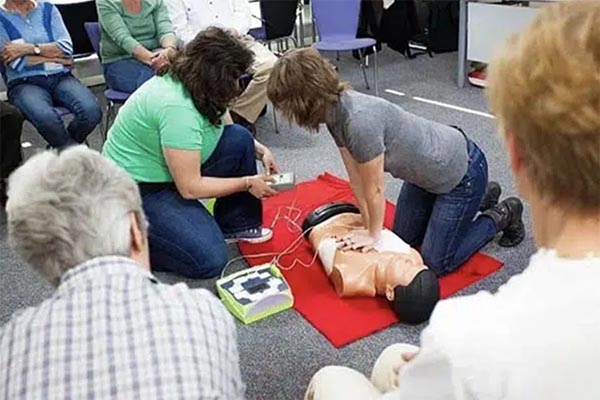
Many people are intimidated by the idea of “shocking” someone, but AED training is designed to remove that fear. In a certified class, you will practice with a “trainer” AED—a device that looks and sounds exactly like the real thing but doesn’t actually deliver a shock.

During your training, you will learn:

  1. How to Power On the Device: This sounds simple, but in a high-stress situation, knowing exactly where the “on” button is matters.
  2. Pad Placement: You’ll learn exactly where to place the adhesive pads on adults, children, and infants to ensure the shock is effective.
  3. Following Voice Prompts: Modern AEDs literally talk to you. You’ll practice listening to the instructions and acting on them.
  4. Safety Precautions: You’ll learn when it’s safe to deliver a shock (e.g., ensuring no one is touching the victim) and how to handle special situations like water or metal surfaces.
  5. Integration: Most importantly, you will learn how to switch between CPR and AED use seamlessly without interrupting compressions for too long.

Do online CPR classes provide adequate AED training?

There is a big difference between watching a video of an AED and actually holding the pads in your hands. While 100% online courses exist, many employers and regulatory bodies (like OSHA) do not accept them because they lack a “skills check.”

A “Blended Learning” or “In-Person” approach is much more effective. In these settings, you get to:

  • Physicality: Feel the click of the pads as you peel them back.
  • Timing: Practice the “rhythm” of pausing compressions while the AED analyzes.
  • Feedback: Have an instructor correct your hand placement or timing in real-time.

For residents in Austin, choosing an in-person session ensures that your certification is not just a piece of paper, but a reflection of actual capability.

Are AEDs safe for untrained people to use?

Yes, AEDs are incredibly safe. They are designed so that even a person with zero training could technically use one successfully. The device will not allow you to shock someone unless it detects a “shockable rhythm.” You cannot accidentally shock someone whose heart is beating normally.

However, certification makes you much faster. In an emergency, speed is everything. A trained person can get an AED pads on and the device analyzing in under a minute, whereas an untrained person might lose precious time reading instructions.

How does the training differ for children and infants?

Cardiac arrest in children and infants is often caused by respiratory issues rather than the primary heart problems seen in adults. Because of this, the training is slightly different.

In a comprehensive CPR/AED course, you will learn:

  • Pediatric Pads: Some AEDs have smaller pads for children under 8 years old or 55 pounds.
  • Attenuators: Some devices use a special “key” or switch to reduce the energy of the shock for a smaller body.
  • Anatomical Placement: Because infants are small, pads are often placed on the front of the chest and the back, rather than both on the front.

Your instructor will guide you through these nuances so you feel prepared to help a person of any age.

How long does a CPR and AED certification last?

Most certifications from reputable providers are valid for two years. The science of resuscitation is constantly evolving. Every five years, the American Heart Association updates its guidelines based on the latest medical research.

Renewing your certification every two years ensures:

  • Your skills stay sharp (muscle memory fades over time).
  • You are up to date on the latest techniques (like the shift toward “Hands-Only CPR” for certain situations).
  • You remain compliant with workplace safety requirements.

Where can I find CPR and AED classes in Austin?

If you are looking for high-quality, hands-on training, CPR Classes Near Me offers convenient locations throughout the Austin area. These classes are designed for everyone from healthcare professionals to teachers, fitness trainers, and parents.

By choosing a local Austin provider, you get instructors who understand the specific needs of the community and provide a supportive environment for learning these life-altering skills.

Conclusion

Enrolling in a CPR certification course is one of the most impactful things you can do for your community and your family. Because modern CPR training almost always includes AED instruction, you will walk away from your class with a complete toolkit for responding to a cardiac emergency.

Don’t wait until an emergency happens to wish you knew what to do. Whether you need certification for work or simply want the peace of mind that comes with being prepared, now is the time to act.

Ready to gain the skills to save a life? 

Contact CPR Classes Near Me today to find an upcoming class in Austin and get certified!

Frequently Asked Questions (FAQ)

Q: Does every CPR class include AED?

A: While nearly all professional and “Heartsaver” level courses include AED training, it is always best to check the course description. If the course is labeled as “CPR/AED,” it is guaranteed to include it.

Q: Can I use an AED if I’m not certified?

A: Yes. Good Samaritan laws in most states protect bystanders who use an AED in good faith to save a life. The device provides voice instructions to help you through the process. However, certification is highly recommended to increase the speed and effectiveness of the rescue.

Q: Is there a separate test for the AED portion?

A: Usually, the AED “test” is integrated into your hands-on CPR skills check. Your instructor will watch to see if you can correctly apply the pads and follow the device’s prompts while maintaining proper CPR cycles.

Q: How much does a CPR/AED class in Austin cost?

A: Prices vary depending on the level of certification (e.g., Basic Life Support for healthcare vs. Heartsaver for the general public), but most classes in Austin range from $60 to $95.
CPR/AED vs BLS: What Is the Difference? Which One Do You Need?

When it’s time to get certified in life-saving skills, you’ll likely run into two main options: CPR/AED and BLS. On the surface, they seem identical. Both involve chest compressions, both teach you how to use a defibrillator, and both save lives.

However, picking the wrong one could mean your employer won’t accept your certificate, or worse, you won’t be trained for the specific environment where you work. Whether you are a fitness instructor in Austin or a nurse at a local hospital, understanding the “why” and “how” behind these certifications is essential for professional compliance and public safety.

What exactly is the difference between CPR/AED and BLS?

The primary difference lies in the target audience and the depth of training.

CPR/AED (Cardiopulmonary Resuscitation & Automated External Defibrillator) is designed for “laypeople”—the general public. It focuses on the basic skills needed to keep someone alive until professional help arrives. It is perfect for people who might encounter an emergency at a grocery store, a gym, or a school.

BLS (Basic Life Support) is a higher-level certification specifically designed for healthcare providers and public safety professionals. It includes everything in a standard CPR course but adds advanced techniques. BLS training assumes you will be working in a team environment (like a hospital or an ambulance) and using professional-grade equipment.

Is BLS more difficult than a standard CPR course?

While “difficult” is subjective, BLS is certainly more comprehensive. In a standard CPR/AED class, you learn how to act as a lone rescuer. In a BLS class, you are trained to work as part of a high-performance team.

Key skill additions in BLS include:

  • Bag-Valve Mask (BVM) Ventilation: Learning to use a manual resuscitator rather than just mouth-to-mouth or a simple pocket mask.
  • Two-Rescuer Scenarios: Coordinating with a partner to switch roles every two minutes to prevent fatigue.
  • Pulse Checks: BLS students are trained to check for a pulse for no more than 10 seconds, a skill not typically emphasized in layperson classes.
  • Advanced Airway Support: How to provide breaths when an advanced airway (like an endotracheal tube) is in place.

Who should choose a CPR/AED certification?

If your job is not in the medical field, CPR/AED is usually the right choice. This certification meets the requirements for OSHA-mandated workplace safety.

You should choose CPR/AED if you are:

  • A Teacher or Coach: Most school districts and athletic departments require this level of training.
  • A Fitness Instructor: Gyms and yoga studios need you to know how to use an AED and perform compressions.
  • A Construction Worker: Many job sites require basic safety certifications.
  • A Parent or Caregiver: If you simply want to be prepared to protect your family, this course provides the essential skills without the medical jargon.
  • A Security Guard: Most security roles only require layperson-level training.

Who is required to have a BLS certification?

If you work in a clinical setting or are a student in a medical program, you almost certainly need BLS. Most healthcare employers will not accept a “Heartsaver” or “CPR/AED” card; they specifically look for “BLS Provider.”

You need BLS if you are:

  • A Nurse or Doctor: Hospitals require BLS as a baseline for all clinical staff.
  • A Dentist or Dental Hygienist: Most state boards require BLS for dental licensure.
  • An EMT or Paramedic: First responders must be experts in team-based resuscitation.
  • A Physical Therapist: Even in outpatient clinics, BLS is the standard.
  • A Medical Student: Most clinical rotations require a current BLS card before you can step onto the floor.

Do the skills taught in CPR/AED and BLS overlap?

Yes, there is significant overlap. Both courses are built on the same American Heart Association (AHA) guidelines. Regardless of which class you take, you will master the “Chain of Survival.”

Common skills in both courses include:

  • Recognizing the signs of cardiac arrest.
  • Performing high-quality chest compressions (depth and rate).
  • Safe and effective use of an AED.
  • Relief of choking (foreign body airway obstruction) for adults and infants.
  • Providing rescue breaths.

The difference isn’t the quality of the compressions; it’s the context in which those compressions are delivered and the equipment used to facilitate breathing.

Which certification does the American Heart Association (AHA) recommend?

The AHA doesn’t necessarily recommend one over the other for everyone; rather, they provide different “tracks” based on your role.

  • The Heartsaver Track: This includes CPR/AED and First Aid. It is written in simple, non-medical language. It is designed to be accessible to anyone regardless of their educational background.
  • The BLS Provider Track: This is written for the medical professional. It uses clinical terminology and focuses on patient outcomes in a professional setting.

In Austin and throughout Texas, most professional organizations follow AHA standards. Ensuring you have an AHA-approved card is often more important than the title of the course itself, as many “online-only” certifications are not recognized by employers or regulatory boards.

How long do these certifications last?

Both CPR/AED and BLS certifications are valid for two years. After 24 months, you must take a renewal or “update” course to maintain your credentials.

Staying current is vital because:

  • Skills Fade: Research shows that CPR skills begin to decline just a few months after training.
  • Updated Guidelines: The AHA updates its science every few years. A renewal class ensures you are using the most effective techniques.
  • Legal Compliance: Most employers require an active card to stay on the schedule.

Can you take a BLS class if you aren’t a healthcare provider?

Absolutely! While BLS is designed for healthcare professionals, anyone can take the course. If you are a “super-user” who wants the most in-depth training available, BLS is a great option. It provides a more technical look at the mechanics of the heart and the science of resuscitation.

However, be prepared for a faster-paced environment and a written exam that assumes a basic understanding of medical concepts. If you aren’t comfortable with technical terminology, the standard CPR/AED class is much more approachable.

How do I find a class near me?

Finding the right class in your local area is easy. You should look for a training center that offers both options so you can be sure you’re getting the right level of training for your career path.

When searching for a class:

  • Check the Provider: Ensure they are an authorized AHA or Red Cross training site.
  • Look for Blended Learning: Many centers offer “HeartCode” or “Simulation Learning,” which allows you to do the book work online and come in person only for the skills check.
  • Verify the Card: Make sure you will receive your eCard the same day so you can provide proof to your employer immediately.

What are the key technical differences in the training?

When you sit down for a BLS class versus a CPR/AED class, you will notice distinct differences in the curriculum.

In a CPR/AED class:

  • You focus on 1-person CPR.
  • You use a simple barrier device for breaths.
  • You are taught to look for “signs of life” or breathing.

In a BLS class:

  • You focus on 1-person and 2-person CPR.
  • You use a Bag-Valve Mask (BVM) which requires two hands to seal correctly.
  • You are taught to check a carotid pulse for at least 5 but no more than 10 seconds.
  • You learn the “team lead” concept to manage a cardiac arrest scene.

Conclusion

Choosing between CPR/AED and BLS doesn’t have to be complicated. If you are a medical professional or student, go with BLS. If you are a teacher, coach, or concerned citizen, CPR/AED is your best bet. Both paths empower you with the confidence to act when a life is on the line.

Regardless of the acronym on your card, the most important thing is that you are trained and ready. Every minute counts in a cardiac emergency, and your training could be the difference between a life lost and a life saved.

Ready to get certified? 

Whether you need a layperson CPR/AED card or a professional BLS Provider certification, we’ve got you covered with expert instructors and flexible schedules. Contact CPR Classes Near Me today to find a session that fits your schedule and career needs!

Frequently Asked Questions (FAQ)

Q: If I have a BLS card, do I also need a CPR/AED card?

No. BLS is a higher level of certification that encompasses all the skills taught in a standard CPR/AED course. If you are BLS certified, you are over-qualified for roles that only require CPR/AED and your card will be accepted.

Q: Does BLS include First Aid?

Not usually. BLS focuses strictly on cardiovascular and respiratory emergencies in a clinical context. Most healthcare providers take First Aid as a separate course if required by their specific job, whereas many “Heartsaver” courses bundle CPR/AED and First Aid together for convenience.

Q: Can I get my BLS certification entirely online?

No. While you can do the “cognitive” (lecture) portion online via an AHA-approved portal, you must attend an in-person skills practice and testing session with a certified instructor to receive a valid BLS Provider card. Employers will generally not accept “online-only” cards without a hands-on component.

Q: What happens if my certification expires?

If your card expires, you are technically no longer certified. Most training centers require you to take the full “Initial” course rather than a shorter “Renewal” course if your card is even one day past its expiration date. It is always better to renew 30 days before the expiration.

Q: Is there an age limit for BLS or CPR classes?

There is no formal age limit set by the American Heart Association. As long as a student can physically perform the compressions to the required depth and pass the skills test, they can be certified. Most instructors find that children around age 10-12 are physically capable of meeting the requirements.

What BLS Means and Who Needs It in Austin: Your Complete Guide

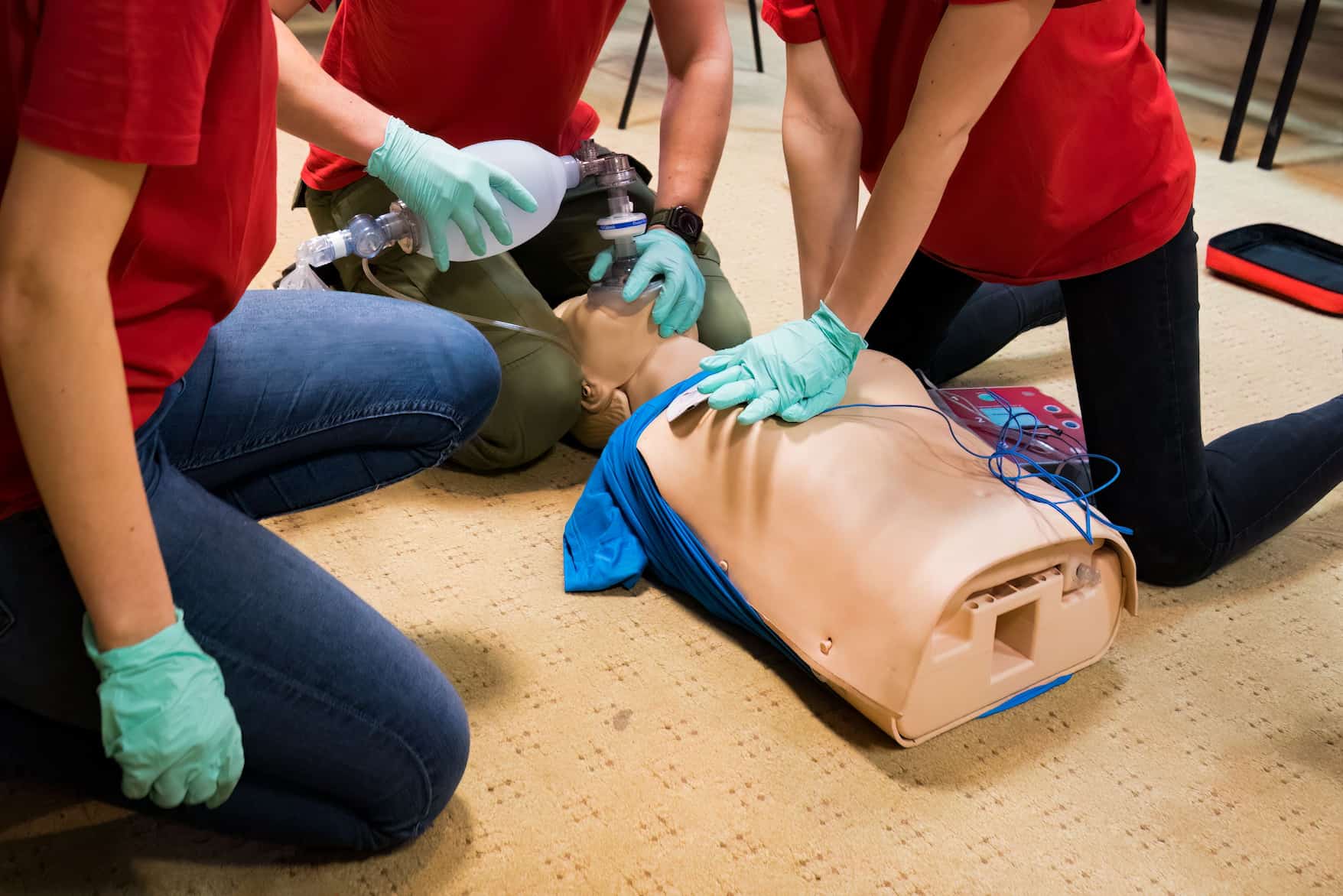
Students performing CPR and ventilation on a training manikin in class

If you are entering the healthcare field or starting a job at a major hospital in Central Texas, you have likely seen the acronym “BLS” on your new-hire checklist. BLS stands for Basic Life Support.

While many people use the terms “CPR” and “BLS” interchangeably, they aren’t exactly the same thing. Think of it this way: CPR is a single life-saving tool, but BLS is the entire professional toolkit. BLS is a specific level of medical care used by healthcare providers and public safety professionals to sustain life in an emergency until “Advanced” care can take over.

In an American Heart Association (AHA) BLS course, you don’t just learn how to pump a chest; you learn the science of high-quality compressions, how to coordinate a multi-person rescue, and how to use medical-grade equipment like a bag-valve mask (BVM). It is the foundational certification that proves you can keep a patient alive during those first critical minutes of cardiac arrest.

Who is required to have BLS certification in Austin?

Austin is a thriving hub for healthcare, home to massive networks like St. David’s HealthCare, Ascension Seton, and Austin Regional Clinic. These institutions, along with state licensing boards, mandate BLS certification for a wide variety of roles.

In Austin, you generally need BLS if you fall into one of these categories:

  • Nursing Professionals: Registered Nurses (RNs), Licensed Vocational Nurses (LVNs), and Certified Nursing Assistants (CNAs) are almost always required to maintain current BLS.
  • Dental Offices: Dentists, Dental Hygienists, and Dental Assistants in Texas must have BLS to comply with state board requirements.
  • First Responders: Firefighters, Police Officers, and EMTs use BLS skills daily as part of their emergency response duties.
  • Therapists and Technicians: Physical Therapists, Occupational Therapists, MRI Technicians, and Respiratory Therapists need BLS to work in clinical or home-health settings.
  • Medical Students: If you are enrolled in a nursing or medical program at UT Austin or Austin Community College, you’ll need your BLS card before you can start clinical rotations.

Why is BLS different from a standard CPR class?

You might wonder why a standard “Heartsaver” or community CPR class isn’t enough for your job. The difference lies in the “Professional” focus of the BLS curriculum.

  1. Pulse Checks: In a standard CPR class, you look for “signs of life.” In BLS, you are trained to perform a professional pulse check.
  2. Team Resuscitation: Most medical emergencies in a hospital involve more than one person. BLS teaches you how to switch roles seamlessly so the patient never loses blood flow.
  3. Advanced Equipment: BLS covers the use of bag-mask devices, which are more effective than mouth-to-mouth but require specialized training to use correctly.
  4. Compression-to-Breath Ratios: While the general public usually learns 30:2, BLS providers learn specific ratios for two-rescuer infant and child rescues (15:2) to ensure the best possible outcomes.

What skills are taught in an Austin BLS course?

When you walk into a classroom at CPR Classes Near Me in Austin, you are there to gain muscle memory, not just watch a video. Our AHA-certified instructors guide you through several core competencies:

  • High-Quality Adult CPR: Learning the exact depth (2 to 2.4 inches) and rate (100–120 bpm) needed to keep a heart pumping.
  • Pediatric Life Support: Adjusting your technique for infants and children, who have different physiological needs during an arrest.
  • AED Operation: Learning how to use an Automated External Defibrillator quickly and safely, which is the only way to “restart” a heart.
  • Choking Relief: Mastering the Heimlich maneuver for adults and the back-slap/chest-thrust method for infants.
  • Bag-Mask Ventilation: Practicing how to provide high-concentration oxygen using a mask and reservoir bag.

Is an online BLS certification valid for Austin employers?

This is a common trap for many professionals. You might see “100% Online BLS” for $20, but be careful. Almost all major Austin employers—including Baylor Scott & White and the major local hospitals—do not accept certifications that are entirely online.

The reason is simple: you cannot prove you can save a life until you have physically demonstrated your skills on a manikin. The American Heart Association requires a hands-on skills session to issue an official eCard. At CPR Classes Near Me, we provide the full, in-person experience so your card is guaranteed to be accepted by your employer.

How long does the BLS certification last?

Once you complete your training and pass your skills test, your BLS certification is valid for two years.

However, don’t wait until the day your card expires to renew. In the healthcare world, an expired card can mean you are immediately pulled from the schedule. We recommend Austin professionals book their renewal class at least 30 days before their current card expires to ensure there is no gap in their credentials.

Where can I find BLS classes in the Austin area?

Finding a class that fits your schedule shouldn’t be a struggle. CPR Classes Near Me offers convenient locations throughout the Austin metro area, including:

  • Austin Proper: Centralized classes for those living near downtown or the UT area.
  • Austin North: Convenient for residents of Pflugerville, Round Rock, and Wells Branch.
  • Surrounding Cities: We also serve Bastrop, Buda, Georgetown, Hutto, Kyle, Lakeway, Leander, and Cedar Park.

Whether you are an individual needing a card for a new job or a clinic manager needing to certify a whole team, we have options that fit. We even offer on-site training where our instructors come to your Austin business or office!

What should I expect on the day of my BLS class?

We know your time is valuable. Our BLS classes in Austin are designed to be efficient and high-yield.

  1. Duration: The class typically takes about 3.7 hours.
  2. Environment: We provide a business-casual, conversational atmosphere where you feel comfortable asking questions.
  3. Materials: You’ll use high-feedback manikins that tell you exactly if your compressions are deep enough.
  4. Same-Day Card: You don’t have to wait for the mail. We issue your American Heart Association BLS eCard the very same day you finish the class.

Why choose CPR Classes Near Me Austin?

There are plenty of training sites in Texas, but we pride ourselves on being the #1 choice for Austin’s healthcare community.

  • AHA Aligned: We strictly follow the latest American Heart Association guidelines.
  • Affordable Pricing: Our BLS classes start at $64.95, which is a $20 discount off the standard rate.
  • Proven Success: We have certified thousands of students across the country and maintain a reputation for excellence in the Austin region.
  • Guaranteed Acceptance: Our cards are OSHA-compliant and recognized by hospitals, schools, and government agencies nationwide.

Conclusion

Understanding what BLS means and who needs it is the first step toward professional readiness in Austin’s competitive healthcare market. Whether you are a nurse at St. David’s, a dental hygienist in Round Rock, or a student just starting out, having a valid AHA BLS certification is your ticket to employment and your commitment to patient safety.

Don’t leave your certification to chance with an unaccredited online course. Get the hands-on training you need to act with confidence when every second counts.

Ready to get certified? 

Contact CPR Classes Near Me today to book your seat or schedule a group training session for your Austin office! Call us at (512) 831-4243 or visit our website to secure your spot.

Frequently Asked Questions (FAQ)

What is the difference between BLS and CPR? 

CPR (Cardiopulmonary Resuscitation) is a foundational skill for the general public, focusing on chest compressions and breaths. BLS (Basic Life Support) is the professional version required for healthcare providers. It includes all CPR skills plus advanced techniques like two-rescuer coordination, bag-mask ventilation, and professional-grade pulse checks.

How much does a BLS class cost in Austin? 

At CPR Classes Near Me, our Austin BLS classes are currently discounted to $64.95. If you also need First Aid certification, we offer a combined BLS and First Aid class for $84.95.

Can I get my BLS card the same day? 

Yes. We issue your official American Heart Association BLS eCard electronically on the same day you successfully complete the course and skills testing.

How long is the BLS certification valid for? 

An AHA BLS certification is valid for two years from the date of issue. After two years, you must take a renewal course to maintain your credentials.

Is there an age requirement for BLS in Austin? 

The American Heart Association does not have a specific minimum age. As long as a student can physically perform the required skills (such as deep chest compressions) and pass the written exam, they can earn their certification.

Do I need a separate CPR card if I have a BLS card? 

No. BLS is a higher-level certification that encompasses all the skills taught in a standard CPR class. If your employer asks for “CPR certification,” a BLS card will almost always satisfy and exceed that requirement.