How to Schedule Group CPR Classes Without Disrupting Operations

first aid training class

Coordinating employee training often feels like a logistical puzzle, especially when your company cannot afford to halt daily productivity. However, ensuring your team is prepared for a medical emergency is not something you can postpone. Safety compliance and workplace readiness are non-negotiable pillars of a successful business.

You might assume that getting your entire staff certified means shutting down the office or running on a skeleton crew for the day. Fortunately, modern training providers have adapted to the fast-paced needs of corporate environments. By utilizing flexible booking strategies and on-site instruction, you can empower your staff with life-saving skills while keeping your business running smoothly.

In this comprehensive guide, you will learn exactly how to seamlessly integrate life-saving training into your corporate calendar. We will cover actionable scheduling strategies, the logistical benefits of on-site instruction, and how to partner with the right training experts. Let’s dive into how you can successfully schedule group CPR classes without ever skipping a beat in your daily operations.

Why Should You Prioritize Group CPR Classes for Your Employees?

Before diving into the logistics of scheduling, it is vital to understand the immense value of team-wide emergency training. Medical emergencies, such as sudden cardiac arrest or severe choking, do not wait for a convenient time to occur. Having a staff trained in the latest American Heart Association (AHA) guidelines can literally mean the difference between life and death.

Beyond the obvious life-saving benefits, group CPR classes keep your business compliant with rigorous safety standards. Organizations across healthcare, education, childcare, and construction are heavily regulated by OSHA. Failing to maintain current certifications can result in hefty fines, legal liabilities, and a tarnished reputation.

Furthermore, team training fosters a profound sense of workplace confidence and camaraderie. When employees know their peers have their backs in an emergency, overall morale improves. Group training sessions naturally double as team-building exercises, allowing co-workers to practice critical communication under pressure.

What Are the Best Strategies for Scheduling Employee CPR Certification?

The secret to maintaining productivity during mandatory training lies in strategic scheduling. You do not have to certify your entire company at the exact same moment. Instead, breaking the staff into manageable cohorts ensures that every department remains adequately staffed.

Here are a few proven scheduling methods that HR managers use to maintain business continuity:

  • The Split-Shift Method: Divide your staff in half. Group A takes the morning class while Group B covers the floor, and they swap after lunch.
  • The Departmental Rollout: Train one specific department at a time over the course of a week. This ensures cross-functional teams remain operational.
  • The Bridge Schedule: Schedule classes during the overlap between first and second shifts. This allows the departing shift to stay slightly later and the incoming shift to arrive slightly early, capturing both groups in one session.

By analyzing your lowest-traffic business hours, you can pinpoint the exact right time to pull employees off the floor. A little proactive calendar management goes a long way in preserving your daily revenue and workflow.

How Does On-Site CPR Training Minimize Business Downtime?

One of the largest time-wasters in corporate training is employee travel. If you send 20 employees to an off-site facility, you are losing hours of billable time just in transit and parking. The most effective way to eliminate this friction is to bring the classroom directly to your facility.

On-site CPR training allows certified instructors to travel directly to your office, warehouse, or clinic. Providers simply pack up their sanitized mannequins, AED trainers, and training materials, setting up a temporary classroom in your conference room or breakroom. This completely erases travel time from your payroll expenses.

Additionally, on-site training allows employees to learn in the exact environment where they might actually need to perform a rescue. Practicing chest compressions in the familiar layout of your own office building helps commit the emergency response plan to memory. When the class wraps up, employees can literally walk out of the conference room and get right back to work.

When Is the Ideal Time to Host Workplace CPR and First Aid Classes?

Timing your training correctly is critical to keeping operations fluid. The “ideal” time varies heavily depending on your industry. For example, a busy dental office might choose to utilize a Friday afternoon when patient volume is historically low.

Consider piggybacking your life-saving training onto events that are already on the corporate calendar. Annual company retreats, scheduled maintenance shutdown days, or mandatory quarterly all-hands meetings are perfect opportunities. Since the staff is already gathered and regular operations are paused, adding a certification class maximizes your time investment.

For industries with 24/7 operations, such as hospitals or manufacturing plants, weekend or evening classes might be necessary. Look for a training provider that offers extended hours and flexible weekend availability to accommodate non-traditional schedules.

How Can You Manage Group Sizes for Hands-On CPR Training?

AHA BLS CPR certification requires strict adherence to hands-on skills testing. Employees must demonstrate proper rescue breathing, chest compression depth, and AED operation. Because of this, massive lecture-hall-style classes are highly ineffective and non-compliant.

To manage group sizes effectively, aim for a ratio that allows individualized attention from the instructor. Small class sizes guarantee that each employee gets adequate time practicing on the mannequins without standing around waiting. While providers can handle large company rosters, they will strategically divide your staff into practical learning groups.

If you have a staff of 50 people, a professional training company might deploy multiple instructors simultaneously to run concurrent small groups. This parallel training model gets your entire staff certified in a fraction of the time without compromising the quality of the hands-on instruction.

What Should You Look for in a Group CPR Training Provider?

Not all safety training companies operate at the same level of excellence. When corporate productivity is on the line, you need a vendor that is punctual, professional, and widely recognized. Your first non-negotiable requirement is ensuring the provider is an official American Heart Association Training Site.

Beyond AHA alignment, evaluate the logistical perks the provider offers. Look for companies that guarantee same-day BLS eCards. Employees who need immediate proof of compliance to legally perform their jobs cannot afford to wait weeks for a physical card to arrive in the mail.

Finally, read their reviews and assess their geographic reach. A company with nationwide locations and thousands of verified five-star reviews demonstrates a proven track record of corporate reliability. You want instructors who are engaging and knowledgeable, ensuring your staff actually pays attention and retains the information.

How Does Employee CPR Certification Benefit Overall Company Safety?

A certified workforce is the cornerstone of a robust corporate safety culture. When an emergency strikes, the national average response time for EMS is between 7 to 10 minutes. Unfortunately, brain damage from a lack of oxygen can begin in as little as four minutes.

By having your team trained in AHA Basic Life Support (BLS), you bridge that dangerous gap between the initial collapse and the arrival of paramedics. Employees learn how to swiftly clear airway obstructions, operate an Automated External Defibrillator (AED), and perform high-quality compressions. This immediate, on-the-spot intervention drastically increases survival rates.

Furthermore, training inherently makes your staff more safety-conscious in their daily routines. Employees become more adept at spotting potential workplace hazards and identifying early warning signs of stroke or cardiac distress in their colleagues or customers.

Can You Customize Your Group First Aid and CPR Certification Course?

Every industry faces its own unique set of occupational hazards. A daycare center deals with infant choking risks, while a construction crew is more likely to encounter severe bleeding or environmental injuries. Therefore, a one-size-fits-all approach to corporate training is rarely the best option.

When scheduling your group CPR classes, ask about bundling modules. The most popular addition is a comprehensive First Aid certification. Adding First Aid to an AHA BLS CPR course creates a well-rounded emergency responder out of your everyday employee.

Top-tier training providers will tailor the scenarios discussed in class to fit your specific workplace. This contextual learning ensures that your staff isn’t just memorizing a textbook, but rather preparing for the exact types of emergencies they are statistically most likely to face on the clock.

What Are the Steps to Prepare Your Facility for On-Site CPR Instructors?

Once you have scheduled your on-site training, a little internal preparation goes a long way in ensuring a smooth session. First, secure a room with ample floor space. Employees will be on their knees practicing chest compressions, so a cramped office will not suffice. Large conference rooms, cafeterias, or empty lobbies work best.

Ensure the room is equipped with basic audiovisual capabilities. AHA curriculum requires the showing of standardized instructional videos, so a reliable TV or projector with sound is necessary. If your facility lacks this equipment, communicate with your training provider in advance so they can bring their own AV gear.

Finally, send out clear communication to your team regarding dress codes. CPR is a physical activity. Remind your staff to wear comfortable, loose-fitting clothing and practical shoes on the day of the training, as they will be moving around and performing physical exertion.

How Do You Get Started with CPR Classes Near Me Today?

Scheduling high-quality, OSHA-compliant safety training does not have to be a logistical nightmare for your operations team. By utilizing smart scheduling tactics, embracing the convenience of on-site instruction, and partnering with industry experts, you can easily prioritize both safety and productivity.

At CPR Classes Near Me, we specialize in seamless corporate training. Our AHA-certified instructors travel directly to your facility, offering flexible scheduling, engaging hands-on instruction, and immediate same-day eCards for your entire team. We make compliance easy so you can get back to doing what you do best—running your business.

Don’t wait for an emergency to realize your team is unprepared. Protect your employees, your customers, and your business by taking action now. Contact CPR Classes Near Me today to request a quote and schedule your tailored group training session!

FAQ

How long does a group CPR class take?

An official AHA BLS CPR class typically takes about 3.7 hours to complete. This includes the required video instruction, hands-on skills practice with mannequins, and the final evaluation. Adding First Aid modules will extend the class time slightly.

Do we get our CPR certification cards the same day?

Yes, when you train with CPR Classes Near Me, your instructors will issue your AHA BLS eCards on the exact same day you complete the course. This immediate processing ensures your staff meets their workplace compliance deadlines instantly.

Can the instructors travel to our office location?

Absolutely. Instructors are available to travel directly to your business, office, or facility across multiple regions. This on-site model saves your staff from traveling and drastically reduces business downtime.

Is the training American Heart Association certified?

Yes, the training is conducted through an official American Heart Association Training Site. The AHA certification is OSHA-compliant and widely recognized as the gold standard by employers and regulatory boards nationwide.

How many employees do we need for a group CPR class?

While minimums can occasionally vary by region, training providers are well-equipped to handle groups of all sizes, from small teams of five to massive corporate rosters. Large groups are split into smaller practical cohorts to ensure everyone gets hands-on practice.

How long is the AHA BLS CPR certification valid?

Upon successful completion of the course, the CPR certification is valid for a full two years. After two years, employees must take a renewal class to keep their skills sharp and their credentials active.
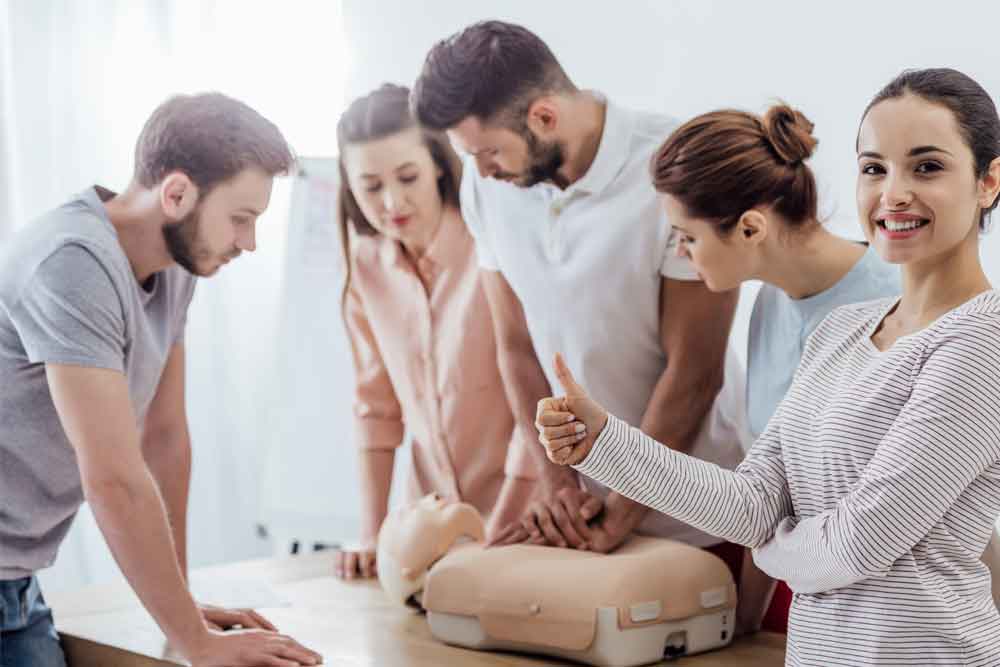
How Group CPR Certification Works for Offices and Teams

Company/Group CPR Classes

When a medical emergency strikes in the breakroom or on the warehouse floor, every single second counts. You simply do not have time to wait for emergency medical services to arrive before someone takes action. By investing in group CPR certification, you empower your entire team to step up and potentially save a coworker’s life.

Many business owners and HR managers understand the importance of workplace safety, but the logistics of training an entire staff can feel overwhelming. Sending employees off-site one by one disrupts productivity and leaves dangerous gaps in your safety coverage. That is exactly where group CPR certification comes in to solve the problem.

In this comprehensive guide, you will learn exactly how group CPR certification works for offices and teams. We will walk through the logistical process of on-site training, the specific life-saving skills your staff will master, and the hidden team-building benefits of learning together. You will also discover why American Heart Association (AHA) guidelines are the gold standard for corporate compliance.

If you are looking to build a safer, more resilient workplace, this guide has everything you need to get started. Let’s dive into how you can turn your everyday employees into confident, capable first responders.

Why Is Group CPR Certification Essential for Workplace Safety and OSHA Compliance?

According to the American Heart Association, more than 10,000 cardiac arrests occur in the workplace every single year. Sudden cardiac arrest can happen to anyone, regardless of their age or apparent fitness level. If an employee collapses in the middle of a meeting, survival depends heavily on immediate chest compressions and the use of a defibrillator.

Beyond the clear moral obligation to protect your staff, there are strict legal and regulatory reasons to schedule group CPR training. The Occupational Safety and Health Administration (OSHA) requires employers to provide a safe and healthy work environment. If your office or job site is not in “near proximity” to a hospital or medical clinic—usually defined as a three-to-four-minute response time—OSHA mandates that you have personnel adequately trained in first aid and CPR.

Training just one or two designated safety officers is rarely enough. What happens if your designated responder is out sick, on vacation, or working remotely on the day an emergency occurs? By certifying a large group or your entire team, you ensure that life-saving knowledge is always present in the building.

Furthermore, widespread training drastically reduces the “bystander effect.” When only one person knows what to do, others tend to freeze in a panic. When an entire office goes through group CPR certification together, a collective sense of responsibility takes over. Employees act decisively, knowing their coworkers have their back.

How Does the On-Site Group CPR Training Process Actually Work for Businesses?

The biggest misconception about corporate CPR training is that it requires a massive logistical headache. In reality, the process is incredibly streamlined and designed to fit effortlessly into your business operations. When you book a corporate session, the instructors bring the entire classroom directly to your facility.

Here is a step-by-step breakdown of how on-site group training usually works:

  • Scheduling the Session: You choose a date and time that minimizes disruption to your workflow. Training can be scheduled during a dedicated morning block, an afternoon development session, or even over a weekend shift.
  • Instructor Arrival and Setup: Certified instructors arrive early with all the necessary training equipment. This includes sanitized adult and infant manikins, training AEDs (Automated External Defibrillators), and disposable barrier masks.
  • Space Requirements: You do not need a fancy auditorium. A standard conference room, a cleared-out breakroom, or an open lobby works perfectly. Instructors just need enough floor space for employees to kneel beside the manikins and practice chest compressions comfortably.
  • Hands-On Instruction: The class is not just a passive video presentation. Instructors guide your team through interactive, physical practice to build critical muscle memory.

This on-site model completely eliminates employee travel time and mileage reimbursements. It also ensures that your staff is learning how to respond to emergencies in the exact environment where those emergencies are most likely to occur.

What Specific Life-Saving Skills Will Your Team Master During Their CPR Class?

A high-quality group CPR certification class covers a wide spectrum of emergency responses. Instructors focus on giving your employees the practical skills they need to stabilize a victim until paramedics take over. The curriculum is rooted in the latest scientific guidelines for cardiovascular care.

During the session, your team will learn how to perform high-quality chest compressions. They will practice the exact depth and rate required to manually pump blood to a victim’s brain and vital organs. Instructors will also teach the proper technique for delivering effective rescue breaths using a pocket mask or barrier device.

Another critical component of the training is mastering the AED. Many offices have an AED mounted on the wall, but very few employees actually know how to turn it on or apply the pads. Your team will practice with trainer AEDs, learning how to follow the device’s voice prompts and deliver a shock safely.

Finally, the class will cover how to respond to severe choking. Employees will learn how to perform the Heimlich maneuver (abdominal thrusts) on adults, as well as specialized techniques for clearing the airways of children and infants. By the end of the class, they will have a comprehensive toolkit for handling the most common workplace medical crises.

What Are the Hidden Team-Building Benefits of Workplace CPR Classes?

Most HR managers book group CPR certification to check a compliance box or improve workplace safety. However, they are often surprised by the profound team-building impact the class has on their staff. Learning how to save a life requires deep cooperation, clear communication, and mutual trust.

During an emergency, chaos is the enemy. Instructors teach teams how to delegate tasks effectively under extreme pressure. One employee learns to point and clearly instruct a specific coworker to call 911, while another is directed to run and grab the office AED. This clear, closed-loop communication translates beautifully back into everyday corporate project management.

Practicing chest compressions is also physically demanding and inherently collaborative. Because a single rescuer can tire out quickly, employees learn how to seamlessly swap out and take turns performing compressions without interrupting the flow of care. This shared physical effort breaks down traditional office hierarchies and silos.

Ultimately, completing a challenging, high-stakes certification together fosters a deep sense of camaraderie. Employees walk away knowing that they are not just colleagues typing on laptops; they are a unified team capable of protecting one another’s lives. That level of psychological safety is invaluable for company culture.

Why Choose American Heart Association (AHA) CPR Certification for Your Office?

When searching for group CPR certification, you will likely encounter dozens of cheap, online-only training programs. While these might seem tempting for the budget, they are completely inadequate for true workplace readiness. The American Heart Association (AHA) Basic Life Support (BLS) and Heartsaver courses are the undisputed gold standard for emergency training.

AHA certification requires live, hands-on skills testing with an instructor present. You cannot learn the physical resistance of a human chest by clicking through a slideshow on your computer. Because of this rigorous standard, AHA certification is the most universally accepted credential by employers, medical facilities, and OSHA inspectors nationwide.

Additionally, AHA courses are backed by decades of peer-reviewed medical research. The guidelines are constantly updated to reflect the absolute best practices in resuscitation science. When your team is AHA-certified, you can rest easily knowing they are using the most current, effective life-saving techniques available.

Finally, navigating the administrative side of AHA certification is easier than ever. Reputable training centers now issue official AHA eCards, completely replacing easily lost paper certificates. These secure, digital credentials can be instantly verified by employers and easily tracked by HR departments for compliance audits.

How Long Does a Corporate Group CPR Certification Class Actually Take?

A major concern for business owners is the amount of downtime required for group CPR certification. Fortunately, modern training is highly efficient and respects your company’s valuable time. You do not need to shut down your entire operation for multiple days to get your team certified.

A standard, comprehensive AHA CPR and AED training class generally takes between three to four hours to complete. This timeframe includes the video instruction modules, the hands-on practice with manikins, and the final skills evaluation. If you choose to add First Aid training to the curriculum, the class will take slightly longer, usually wrapping up in a single half-day session.

To minimize workflow disruptions, many companies choose to split their workforce into two smaller groups. One group completes their certification in the morning, while the other handles office operations. Then, they swap places in the afternoon.

Keep in mind that this half-day time investment pays massive dividends. Once your employees successfully complete the class and their skills evaluation, their American Heart Association CPR certification remains valid for two full years.

How Can You Schedule Group CPR Training with CPR Classes Near Me?

Setting up a safer workplace is one of the best investments you will ever make in your team. Your employees deserve the confidence of knowing what to do in an emergency, and you deserve the peace of mind that comes with full OSHA compliance. But you shouldn’t have to navigate complicated logistics to make it happen.

At CPR Classes Near Me, we make the process incredibly simple. Our highly experienced, AHA-certified instructors travel across the country to deliver top-tier training directly to your office, warehouse, or facility. We provide all the manikins, AED trainers, and supplies necessary for a comfortable, engaging, and highly effective learning experience.

We pride ourselves on offering same-day certification cards. As soon as your team completes their skills evaluation, we will issue their official American Heart Association BLS eCards that exact same day. No waiting for weeks, and no administrative headaches for your HR team.

Ready to protect your workplace and build a stronger, more confident team? Contact CPR Classes Near Me today to schedule your on-site group CPR certification. Let us bring the classroom to you so you can get back to doing what your business does best.

Frequently Asked Questions

Can we do group CPR training at our own office location?

Yes, on-site training is the most popular option for corporate teams. Certified instructors will travel to your facility with all necessary equipment, allowing your staff to learn life-saving skills in the environment where they actually work. You just need a space large enough for employees to practice on floor manikins.

Is online-only CPR certification acceptable for workplace compliance?

Generally, no. Most employers and regulatory bodies, including OSHA, require a hands-on skills evaluation to consider an employee fully certified. While blended learning (online coursework followed by an in-person skills check) is acceptable, strictly online courses without physical practice do not meet the American Heart Association standard.

How many employees need to be CPR certified in an office?

OSHA guidelines state that if a medical facility is not in near proximity (3 to 4 minutes away), an adequate number of employees must be trained to render first aid and CPR. Many companies choose to train their entire staff to ensure a certified responder is always present, regardless of vacations or sick days.

How long is an AHA corporate CPR certification good for?

An American Heart Association CPR and AED certification is valid for exactly two years from the date of the completed class. To maintain active certification and workplace compliance, employees must complete a renewal course before their expiration date.

Will our team get their certification cards on the same day as the class?

Yes, when you train with a premium provider like CPR Classes Near Me, your team will receive their official AHA eCards on the exact same day they pass the course. These digital cards are highly secure, OSHA-compliant, and easy for HR departments to keep on file.

Group CPR Training in Austin: Onsite Business Classes

cpr classes near me

Austin is booming with innovative tech companies, thriving educational institutions, and expansive healthcare facilities. As your organization grows in this dynamic city, the safety and well-being of your employees and clients must remain a top priority. Medical emergencies can happen anywhere, and having a team prepared to act confidently can literally mean the difference between life and death.

That is exactly why group CPR training in Austin is becoming a standard practice for forward-thinking organizations. Instead of sending employees to individual classes on their own time, you can bring the classroom directly to your workplace.

In this comprehensive guide, you will learn how onsite group CPR certification works, what vital skills your team will acquire, and why the American Heart Association (AHA) standard is the only credential you should trust. We will also show you how easy it is to schedule a hands-on, team-building safety session that checks all the boxes for workplace compliance and peace of mind.

Why Is Group CPR Training in Austin Crucial for Your Business?

Medical emergencies do not wait for a convenient time to occur. Sudden cardiac arrest can strike anyone, regardless of their age, lifestyle, or physical fitness level. When a health crisis happens in the workplace, the first few minutes are absolutely critical to the victim’s survival.

Relying solely on a 911 call is not always enough. Even with Austin’s highly dedicated emergency response teams, heavy traffic on I-35 or the MoPac Expressway can delay paramedics from reaching your facility immediately. Having employees equipped with CPR and AED knowledge ensures that life-saving interventions begin the moment a colleague or client collapses.

Investing in a comprehensive safety program also protects your company legally and operationally. Many industries face strict OSHA regulations regarding workplace safety and emergency preparedness. Hosting a group training session guarantees that your entire staff meets these regulatory requirements simultaneously, completely removing the guesswork from HR compliance tracking.

Furthermore, offering this training demonstrates a profound commitment to your team’s welfare. Employees feel valued and protected when their employer actively invests in their health, safety, and professional development.

What Are the Benefits of Onsite Classes for Businesses and Teams?

Organizing individual training sessions for a large staff can quickly become an administrative nightmare. Tracking various expiration dates, reimbursing multiple individual invoices, and managing staggered time-off requests heavily drains HR resources. Onsite group classes eliminate these logistical headaches entirely.

By scheduling an onsite session, our expert instructors bring the necessary teaching equipment directly to your conference room, warehouse, or facility. This means zero travel time for your employees and minimal disruption to your daily operations. You dictate the date and time that aligns perfectly with your business schedule.

Group training also serves as an exceptional team-building exercise. Employees learn to communicate clearly and collaborate effectively under high-pressure scenarios. They practice handing off chest compressions and coordinating emergency responses with the exact colleagues they would rely on in a real-world workplace crisis.

Finally, private group sessions are highly cost-effective for organizations. Training your staff as a unified group often reduces the per-person cost compared to individual enrollments. It is a smart, economical decision that yields immeasurable returns in workplace safety and employee confidence.

Which Austin Organizations Need Group CPR Certification the Most?

Virtually every workplace benefits from having certified lifesavers on staff. However, certain industries across the Central Texas region consider this hands-on training an absolute operational necessity.

Healthcare and dental professionals are naturally at the top of the list. Clinics, nursing homes, and medical offices surrounding hubs like the Dell Seton Medical Center require immediate, synchronized emergency responses. AHA Basic Life Support (BLS) is the standardized mandate for these dedicated healthcare workers.

Educators and childcare providers also carry an immense daily responsibility. Schools, daycares, and after-school programs in neighborhoods from Pflugerville to South Congress must be prepared for unexpected pediatric emergencies. Knowing how to handle a choking infant or child is a non-negotiable skill for professional caretakers.

Additionally, fitness centers, construction sites, and hospitality venues face unique physical risks. Gyms around The Domain and construction crews expanding the downtown Austin skyline rely on fast action during physical trauma or cardiac events. Even standard corporate offices benefit immensely from having a designated emergency response team stationed on every floor.

What Does Our Onsite Group CPR Training in Austin Include?

When you book a private session with CPR Classes Near Me, you are not just getting a generic video lecture. Our curriculum is deeply interactive, fully hands-on, and backed by the latest medical science and AHA guidelines.

First, your team will learn the precise mechanics of high-quality chest compressions and proper rescue breathing. We provide individual training manikins so everyone gets ample physical practice. Developing this muscle memory is vital when adrenaline kicks in during a real-life emergency.

Next, we extensively cover the use of an Automated External Defibrillator (AED). These critical devices are increasingly common in Austin office buildings and public spaces, but they can be intimidating to use without prior instruction. We demystify the AED, showing your team exactly how to deploy it safely, quickly, and effectively.

Our comprehensive training prepares your team to treat victims of all ages. Your staff will learn the distinct physiological differences between administering aid to adults, children, and infants. We also include essential, hands-on instruction on clearing airway obstructions for choking victims of any size.

Best of all, there is no waiting around for credentials to arrive in the mail. Upon successful completion of the in-person course, our instructors issue official American Heart Association certification eCards on the exact same day.

How Do Onsite First Aid and CPR Classes Complement Each Other?

While CPR and AED training specifically addresses catastrophic cardiac events, everyday workplace injuries require a completely different medical skill set. Combining First Aid instruction with your group CPR training creates a truly comprehensive safety net for your organization.

First Aid training covers common workplace emergencies like severe bleeding, burns, allergic reactions, and physical trauma. For manufacturing plants, busy restaurants, and large corporate campuses, these localized incidents are statistically much more likely to occur than full cardiac arrest.

By booking a combined onsite class, your employees learn how to seamlessly transition between different emergency protocols. They will know exactly when to apply a bandage or tourniquet versus when to begin chest compressions. This dual knowledge minimizes workplace panic and empowers your staff to manage almost any health crisis until professional paramedics arrive.

How Does the American Heart Association Standard Elevate Your Team?

Not all safety certifications are created equal in the eyes of employers or regulators. The American Heart Association is the undisputed gold standard in emergency cardiovascular care. Their rigorous guidelines dictate how medical professionals and first responders operate nationwide.

Many discount websites offer “online-only” certifications that take just a few minutes to quickly click through. Unfortunately, these cut-rate programs are almost never accepted by employers, OSHA compliance officers, or state licensing boards. You simply cannot learn how to perform adequate, life-saving chest compressions by looking at a computer screen.

Our AHA-aligned classes strictly require an in-person, hands-on skills evaluation. This physical requirement guarantees that your employees actually possess the bodily capability and mental confidence to perform life-saving techniques. Employers across every major sector recognize, respect, and trust the AHA seal.

Once earned, this high-level credential remains valid for two full years. We make the future renewal process just as seamless, offering identical, streamlined refresher courses to keep your Austin team compliant and confident for the long haul.

How Do You Prepare Your Texas Office for Onsite CPR Classes?

Hosting an onsite training session is incredibly straightforward and stress-free. Our expert team handles all the heavy lifting and equipment transport, but a little bit of internal preparation ensures a flawless experience for your staff.

First, you will need to secure an appropriate space within your building. A large conference room, an open breakroom, or a cleared-out lobby works perfectly. We simply need enough open floor space for attendees to kneel next to the training manikins comfortably. A TV screen or blank wall for projecting the required AHA instructional videos is also highly recommended.

Next, advise your participating team members to dress comfortably. CPR is a surprisingly physical activity. Participants will be on the floor performing continuous chest compressions, so flexible, athletic, or casual clothing is highly encouraged.

Finally, communicate the training schedule clearly to all department heads. American Heart Association guidelines require students to be fully present for the entire video and hands-on session. Ensure your staff can dedicate the necessary time without needing to step away for phone calls or secondary meetings.

Why Choose CPR Classes Near Me for Your Corporate Training?

With so many logistical challenges involved in running a successful business, your safety training provider should be a reliable partner you never have to worry about. CPR Classes Near Me has proudly trained and certified thousands of students nationwide, maintaining a stellar reputation built on excellence and reliability.

Our instructors are the true heart of our training program. They are seasoned professionals who specialize in creating a supportive, engaging, and stress-free learning environment. They do not just read monotonously from a manual; they share practical, real-world insights that help students overcome the fear of stepping up during a crisis.

We also boast over 24,000 verified positive reviews from satisfied students and corporate clients. Whether you operate a tight-knit startup in East Austin or a massive corporate campus in Round Rock, we seamlessly scale our instruction to meet your exact organizational needs.

By bringing our top-rated program directly to your door, we save you immense amounts of time, money, and administrative hassle. We focus entirely on the training, so you can focus entirely on running your business.

Equip Your Austin Team to Save Lives

Medical emergencies are inherently unpredictable, but your team’s response absolutely does not have to be. Investing in group CPR training in Austin is one of the most responsible, high-impact decisions a business leader can make. It actively fosters a culture of safety, builds vital team cohesion, and ensures your organization remains fully compliant with industry regulations.

Do not wait for a workplace crisis to realize the true value of emergency preparedness. Equip your staff with the knowledge, muscle memory, and universally accepted AHA certification they need to save a life.

Ready to empower your workforce? Contact CPR Classes Near Me today to schedule your onsite group training and secure your team’s same-day certifications!

Frequently Asked Questions (FAQ)

How many employees are required to book an onsite group CPR class in Austin?

We accommodate groups of various sizes, ranging from small dedicated teams to entire corporate departments. Reach out to our coordination team with your estimated headcount, and we will tailor the instructor ratio to match your specific needs perfectly.

Are online-only CPR certifications valid for Austin businesses?

In most cases, no. Online-only programs lack the hands-on skills assessment required by OSHA and most major employers. To ensure full compliance, CPR training must include an in-person, physical evaluation with a certified instructor.

How long does the onsite CPR and AED training take?

A comprehensive Basic Life Support (BLS) CPR and AED class typically takes about 3.5 to 4 hours to complete. This includes the required AHA video modules, hands-on practice, and the final skills evaluation.

What is the difference between BLS and standard CPR?

Basic Life Support (BLS) is a more advanced, rigorous form of CPR training typically required for healthcare professionals and clinical staff. It heavily emphasizes high-quality chest compressions, multi-rescuer team dynamics, and precise AED usage compared to standard layperson CPR.

Do employees receive their CPR certification cards immediately?

Yes, they do. As soon as your team successfully completes the hands-on skills test at the end of the session, our instructors will issue official American Heart Association certification eCards on the very same day.

How often do businesses need to renew their group CPR certifications?

American Heart Association CPR and BLS certifications are valid for exactly two years from the date of issue. Businesses should schedule a group renewal class before the two-year mark to ensure there are no gaps in regulatory compliance.