
BLS vs CPR vs First Aid: Which Certification Do You Need in Austin?
Whether you’re a nursing student at UT Austin, a new coach for a West Lake youth soccer team, or a tech professional in the Silicon Hills wanting to be prepared, you’ve likely realized that “CPR” isn’t just one single class.
When you start looking for training, you’ll see terms like BLS, CPR/AED, and First Aid thrown around. Choosing the wrong one can mean wasted time and a certification your employer won’t accept.
In Austin, where healthcare and education sectors are booming, knowing the difference is vital. This guide will help you navigate the requirements so you can book the right class at CPR Classes Near Me Austin and get certified with confidence.
What is the difference between BLS and CPR?
Many people use the terms BLS and CPR interchangeably, but in the world of professional certification, they are quite different.
CPR (Cardiopulmonary Resuscitation) is the foundational skill. It is designed for the “layperson”—someone who is not a healthcare professional. A standard CPR class focuses on:
- Recognizing cardiac arrest.
- Performing high-quality chest compressions.
- Giving rescue breaths.
- Using an Automated External Defibrillator (AED).
BLS (Basic Life Support), on the other hand, is the healthcare-level version of CPR. It includes everything in a standard CPR class but adds advanced techniques required in a clinical or team-based setting.
If you are a nurse, a dental assistant, or an EMT, you almost certainly need BLS. If you are a parent or a fitness instructor, standard CPR is usually the right fit.
Is BLS more advanced than a standard CPR course?
Yes, BLS is considered the “professional grade” version of life-saving training. While the chest compressions are essentially the same, the context of the training changes significantly.
In a BLS course at our Austin location, you will learn:
- Multi-Rescuer Coordination: How to work as part of a high-performance team during a resuscitation attempt.
- Bag-Mask Ventilation: Using professional medical equipment to provide breaths rather than just mouth-to-mouth.
- Pulse Checks: Learning to accurately identify a pulse in adults, children, and infants.
- Advanced Airway Management: How to provide care when advanced breathing tubes or equipment are in use.
BLS moves faster and assumes the student may be working in a hospital, clinic, or emergency vehicle where more resources are available.
What does a First Aid certification cover that CPR doesn’t?
It is a common misconception that a CPR card covers all medical emergencies. In reality, CPR is specifically for when someone’s heart has stopped or they are not breathing.
First Aid is the “everything else” certification. It focuses on stabilizing a victim until professional help arrives. At CPR Classes Near Me Austin, our First Aid training covers:
- Injury Management: Bandaging, splinting, and treating burns or broken bones.
- Medical Emergencies: Recognizing and responding to strokes, heart attacks, and seizures.
- Environmental Issues: Treating heatstroke (a big concern in Austin summers!) and hypothermia.
- Allergic Reactions: Proper use of an epinephrine pen (EpiPen).
If your job involves physical labor or supervising children, you will likely need a certification that combines both CPR and First Aid.
Who is required to get BLS certification in Austin?
Austin is home to a massive medical community, from St. David’s and Ascension Seton to the Dell Medical School. If you work in these environments, BLS is the non-negotiable standard.
Common professions in Austin requiring BLS include:
- Registered Nurses (RNs) and LVNs.
- Certified Nursing Assistants (CNAs).
- Physicians and Medical Students.
- Dentists and Dental Hygienists.
- Physical and Occupational Therapists.
- Paramedics and Firefighters.
- Pharmacists.
Most of these employers specifically require the American Heart Association (AHA) BLS Provider card, which is exactly what we provide at our Austin training sites.
Which professions in Austin need CPR and First Aid?
If you don’t work in a hospital but your job involves the safety of others, you likely need a combination of CPR, AED, and First Aid. This is often driven by OSHA requirements or state licensing boards.
In Austin, this typically applies to:
- Educators and School Staff: Teachers and coaches in AISD and surrounding districts.
- Childcare Providers: Daycare workers, nannies, and camp counselors.
- Fitness Professionals: Personal trainers and CrossFit coaches.
- Construction and Skilled Trades: Electricians and site supervisors often need First Aid for OSHA compliance.
- Hospitality and Security: Flight attendants and security guards at Austin-Bergstrom International Airport or major downtown venues.
Can I get my certification card the same day in Austin?
One of the biggest frustrations with some national providers is waiting weeks for a physical card to arrive in the mail. At CPR Classes Near Me Austin, we’ve solved that.
We issue your official American Heart Association (AHA) eCard on the same day you complete your class. This means:
- You can show it to your employer immediately.
- You don’t have to worry about losing a paper card.
- The digital card is easy to verify online by any hiring manager.
Whether you are taking BLS or the CPR/First Aid combo, you walk out of our doors fully certified.
Why should I choose an American Heart Association (AHA) course?
While there are many “off-brand” online courses that claim to offer certification for $20, most Austin employers will not accept them.
The American Heart Association is the industry leader. Their guidelines are based on the latest science in resuscitation. When you hold an AHA card:
- It is Nationally Recognized: You can take your certification to any state.
- It is Employer Accepted: Almost all hospitals and school districts in Texas mandate AHA-aligned training.
- It is OSHA-Compliant: It meets the federal standards for workplace safety.
Don’t risk having to pay for a second class because your first one wasn’t AHA-approved.
How long do these certifications last before they expire?
Both BLS and standard CPR/First Aid certifications are valid for two years from the date of your class.
The renewal process is straightforward:
- BLS Renewal: You attend a standard BLS class to refresh your skills and get a new two-year card.
- CPR/First Aid Renewal: A combined class ensures all your skills stay sharp and your credentials remain current.
We recommend booking your renewal at least 30 days before your current card expires to ensure you don’t have a gap in your employment eligibility.
What should I expect during my Austin CPR or BLS class?
We believe that learning life-saving skills shouldn’t be stressful or boring. Our instructors in Austin focus on hands-on practice.
- Video Instruction: You’ll watch AHA-authorized videos that demonstrate the correct techniques.
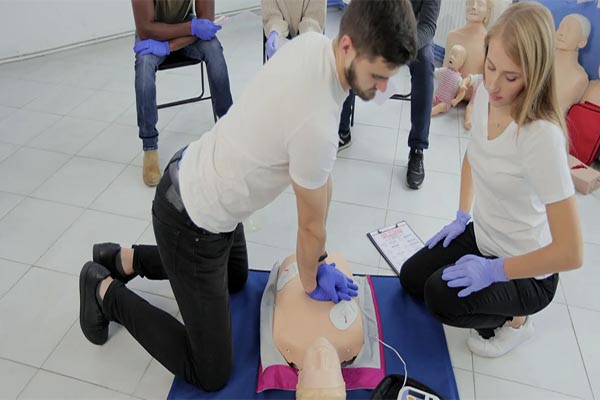
- Manikin Practice: You will spend plenty of time practicing chest compressions and rescue breaths on high-quality manikins.
- AED Training: You will practice using a trainer AED so you know exactly how the device “talks” to you during an emergency.
- Skills Testing: The instructor will observe your techniques to ensure you feel confident and capable.
- Final Quiz: A short written or verbal assessment to confirm you’ve understood the key concepts.
How do I know which class is right for me?
If you are still staring at the registration page wondering which button to click, ask yourself these three questions:
- Does my job require me to work in a clinical setting? If yes, choose BLS.
- Am I a teacher, parent, or coach? If yes, choose CPR/AED & First Aid.
- Do I just want to be prepared for family emergencies? Choose CPR/AED.
If you are still unsure, you can always call our Austin office at (512) 831-4243, and we can help you match the class to your specific job description.
Conclusion
Navigating the world of emergency certifications doesn’t have to be complicated. Whether you need the advanced team-dynamics of BLS, the foundational life-saving power of CPR, or the broad medical knowledge of First Aid, getting certified is a vital step in protecting the Austin community.
At CPR Classes Near Me Austin, we provide the highest quality American Heart Association training with the convenience of same-day eCards and expert instructors. Don’t wait until an emergency happens to realize you aren’t prepared.
Ready to get certified? Contact CPR Classes Near Me Austin today to find a class that fits your schedule and career needs!
Frequently Asked Questions (FAQ)
Q: Can I take my CPR or BLS certification entirely online?
A: No. While some “blended” options allow for online book-work, the American Heart Association requires an in-person skills check with a certified instructor. Most Austin employers will not accept 100% online certifications because they lack hands-on verification.
Q: Is there an age requirement for CPR classes in Austin?
A: There is no formal minimum age. As long as a student can physically perform the compressions and pass the skills test, they can be certified. We have successfully trained many teenagers and young adults.
Q: How much do the classes cost?
A: In Austin, our BLS classes are currently discounted to $64.95. The combined CPR, AED, and First Aid class is offered at $84.95. These prices include your same-day AHA eCard.
Q: Does BLS include First Aid?
A: No. BLS is focused strictly on cardiac arrest and respiratory emergencies. If your employer requires both BLS and First Aid, you will need to take a combined course or add a First Aid module to your training.
Q: Where are the classes located?
A: We have training sites serving Austin, North Austin, Pflugerville, Round Rock, and the surrounding areas. We also offer on-site group training for businesses and organizations throughout Central Texas.