Local Training Standards for Austin Healthcare Providers
In the fast-paced medical ecosystem of Central Texas, professional competence and compliance are non-negotiable. Whether you are managing patient care in a major hospital network or assisting in a local specialized clinic, emergency preparedness forms the baseline of your daily practice. For medical professionals across Travis, Williamson, and Hays counties, keeping your lifesaving credentials active is both a regulatory requirement and a profound professional obligation.
This comprehensive guide will outline exactly how to secure your American Heart Association (AHA) Basic Life Support (BLS) credentials in Austin. We will review specific requirements for varying medical roles, explore what you will master during hands-on training, and explain why choosing an accredited, in-person course matters to your employers. You will learn how to earn an official, workplace-accepted certification card on the very same day you attend your session.
Why Do Austin Medical Employers Require AHA BLS Certification?
The American Heart Association sets the global benchmark for cardiopulmonary resuscitation and emergency cardiovascular care. In Austin, institutional employers—ranging from sprawling hospital networks to private outpatient surgical centers—strictly mandate AHA BLS certification rather than generic, unaccredited online programs. The primary reason for this rigid requirement is standardized clinical excellence and strict compliance with national safety guidelines.
When a patient experiences sudden cardiac arrest within a medical facility, every second dictates their clinical prognosis. The AHA BLS framework prepares healthcare providers to execute high-quality chest compressions and coordinated multi-rescuer interventions with flawless precision. Having an AHA credential demonstrates to clinical directors, regulatory inspectors, and insurance underwriters that you have proven your technical competence under the direct observation of a certified instructor.
Furthermore, these credentials are fully compliant with the Occupational Safety and Health Administration (OSHA) regulations. Hospital compliance officers cannot risk the legal and operational liabilities associated with unapproved or purely digital certifications. Securing an authentic AHA BLS eCard ensures that your credentials will be universally recognized by licensing boards and credentialing departments across the country.
Which Austin Healthcare Professionals Need an Official BLS Credential?
Registered Nurses and Advanced Practice Clinicians
Registered Nurses (RNs), Nurse Practitioners (NPs), and clinical nurse leaders are the primary line of defense in acute care environments. Hospitals require these professionals to possess advanced rescuer skills because they routinely manage complex resuscitation scenarios. An authoritative BLS certification ensures that nursing staff can seamlessly lead a code, delegate roles, and deliver high-quality ventilation within a multi-disciplinary medical team.
Certified Nursing Assistants and Patient Care Technicians
Certified Nursing Assistants (CNAs) and Patient Care Technicians (PCTs) spend the highest percentage of direct, face-to-face time with hospitalized patients and long-term care residents. Because they are frequently the first to identify an unresponsive patient, their capacity to initiate immediate, high-quality chest compressions is a critical factor in patient survival. Obtaining a valid BLS card ensures that these frontline workers can confidently sustain systemic perfusion until the code team arrives.
Medical Assistants and Outpatient Office Personnel
Medical Assistants (MAs) and administrative clinical staff operating within private practices, urgent care centers, and dental offices must remain perpetually ready for emergencies. While outpatient environments may feel less critical than an intensive care unit, cardiac events can happen unexpectedly in any waiting room or exam area. A robust BLS certification equips office personnel to operate automated external defibrillators (AEDs) and clear critical airway obstructions quickly.
Dental Professionals, Physical Therapists, and Allied Health Staff
Dental hygienists, physical therapists, occupational therapists, and clinical technicians are routinely subject to strict licensing board requirements regarding life support training. Because many of these professions involve physical exertion or the administration of local anesthetics, the risk of an adverse medical event is always present. Maintaining a verified BLS credential keeps these allied health practitioners fully compliant with Texas state regulatory guidelines.
What Life-Saving Skills Are Taught in an Austin BLS Course?
Master High-Quality Chest Compressions for All Age Groups
The core foundation of effective Basic Life Support is the delivery of high-quality chest compressions that maintain mechanical blood flow to vital organs. During your training session, you will learn the exact physical mechanics required for adult, child, and infant resuscitation. Instructors emphasize correct hand placement, optimal compression depth (at least 2 inches for adults), and allowing full chest recoil between compressions.
Utilize an Automated External Defibrillator with Complete Confidence
An Automated External Defibrillator (AED) is a vital technological tool used to interrupt lethal cardiac arrhythmias like ventricular fibrillation. Your training includes comprehensive, hands-on practice with specialized AED training units to ensure you can operate them rapidly under pressure. You will learn how to apply electrode pads correctly, safely deliver a shock, and troubleshoot device voice prompts while keeping active chest compressions going.
Execute Advanced Ventilation Techniques Using Barrier Devices
Proper ventilation provides crucial oxygenation to a patient whose breathing has ceased. In an authorized healthcare provider class, you will master advanced airway management using pocket masks and bag-mask ventilation devices. You will practice securing an effective seal using the advanced “E-C” hand technique, which allows you to deliver measured, visible chest rises without causing gastric inflation.
Coordinate Efficient Resuscitation Efforts within a Multi-Rescuer Team
In a professional healthcare setting, resuscitations are rarely performed alone. This course places a heavy emphasis on team dynamics and clear, closed-loop communication strategies during a multi-rescuer resuscitation attempt. You will practice smoothly alternating roles every two minutes to prevent rescuer fatigue, maintaining precise compression-to-ventilation ratios, and systematically organizing a chaotic scene into an efficient medical response.
Clear Severe Airway Obstructions for Adults, Children, and Infants
Choking emergencies require rapid clinical intervention before a patient loses consciousness and progresses into full cardiac arrest. You will learn the precise physical protocols needed to relieve severe foreign-body airway obstructions across all stages of human development. Training covers abdominal thrusts for conscious adults and children, chest thrusts for pregnant or obese patients, and the specialized back-slaps and chest-thrust sequence mandated for choking infants.
Why Must Healthcare Providers Choose In-Person CPR Training Over Online Courses?
While the convenience of purely digital, text-based online courses can seem appealing, healthcare employers routinely reject these certificates. The fundamental reason is that life-saving motor skills cannot be accurately learned, practiced, or evaluated through a computer screen or a multiple-choice digital quiz. True clinical competence requires tactile muscle memory developed through physical manipulation of medical training equipment.
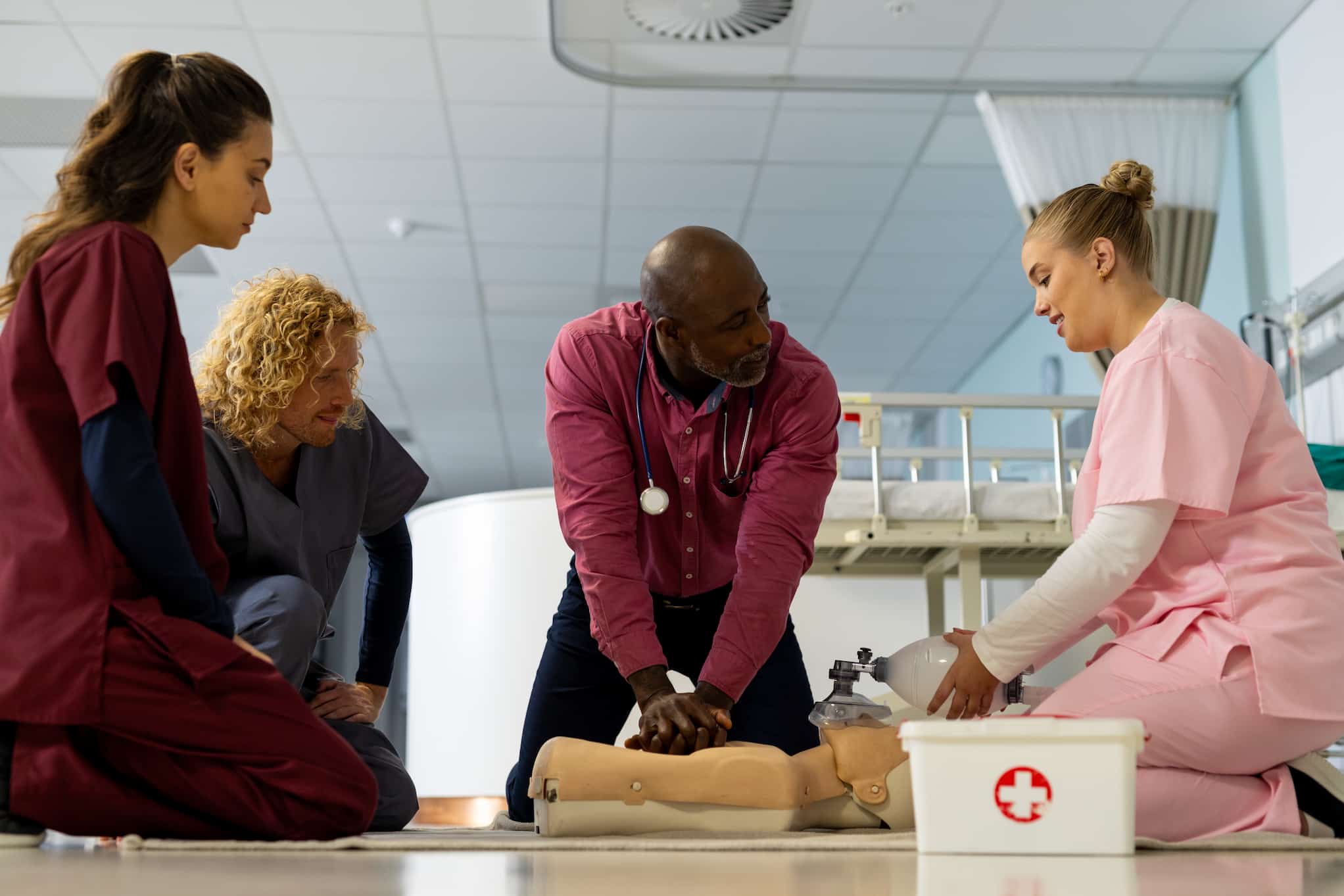
When you enroll in an authentic, in-person training class, you receive immediate, corrective feedback from an experienced, certified instructor. You will practice on anatomical manikins that provide realistic physical resistance, allowing you to gauge the correct force needed for effective chest compressions. This hands-on interaction ensures that you will not hesitate or apply incorrect, hazardous techniques when a real human life hangs in the balance.
In-person courses also give you access to real clinical equipment, such as functional bag-mask ventilators and realistic AED trainers, which are impossible to replicate in a virtual environment. Medical credentialing departments require this objective verification of your physical skills before granting clinical privileges. Choosing an accredited in-person session guarantees that your time and financial investment will result in a fully compliant, universally accepted certification card.
What Can You Expect During an Austin BLS Certification Session?
An authorized American Heart Association BLS class is designed to be highly structured, practical, and time-efficient for busy medical professionals. The entire instructional session takes approximately 3.7 hours to complete from start to finish. During this time, you will watch the official instructional video segments required by the AHA and immediately transition into structured, hands-on practice intervals led by your instructor.
The classroom environment is designed to be supportive, professional, and entirely focused on student success. Instructors guide you through step-by-step skill building, starting with basic individual actions and progressing into complex multi-rescuer team simulations. Because the curriculum is highly immersive and kinetic, the session moves quickly, keeping you engaged and confident throughout the training.
At the conclusion of the instructional modules, you will complete a straightforward skills assessment and a multiple-choice written exam. Because the instructor monitors your technique and provides real-time guidance throughout the class, you will be thoroughly prepared to meet the evaluation standards. Upon meeting these criteria, your official American Heart Association BLS Provider eCard will be generated and issued to you on the exact same day.
This fully in-person training program delivers an immersive and collaborative educational environment. By practicing alongside other Austin-area healthcare providers, you gain practical experience managing real-time rescue dynamics. This shared training approach ensures that every participant leaves the classroom fully prepared to handle real clinical emergencies with precision.
How Can Medical Teams Arrange On-Site Group Training Across Central Texas?
For medical practices, dental clinics, and corporate healthcare offices, coordinating individual training schedules for an entire staff can be a major logistical challenge. To resolve this, specialized on-site group training options allow an elite team of certified instructors to bring the entire classroom directly to your facility. This private arrangement eliminates employee travel time and minimizes disruptions to your clinical operating hours.
On-site group sessions are tailored to fit the unique scheduling needs of your organization, offering flexible morning, afternoon, or weekend availability. Instructors supply all necessary training equipment—including sanitary manikins, training AEDs, barrier devices, and educational media—directly to your location. This ensures your entire staff learns together in their actual day-to-day working environment, which significantly enhances your clinic’s cohesive emergency response capabilities.
In addition to matching your schedule, group training provides an exceptionally cost-effective solution for maintaining corporate regulatory compliance. Every employee who successfully completes the session receives their official AHA credential on the same day, keeping your entire office fully compliant with OSHA and state licensing requirements simultaneously. This comprehensive approach simplifies your administrative tracking and ensures your team remains constantly prepared for emergencies.
Secure Your Same-Day AHA BLS Certification Card Today
Do not risk your employment status or clinical placement with an unaccredited or expired credential. Securing an official, workplace-accepted American Heart Association BLS eCard is a seamless and highly efficient process designed entirely around the schedules of busy healthcare professionals. With local, fully accredited training sites conveniently located across the Austin metropolitan area, getting certified has never been more accessible.
Take immediate control of your professional compliance and clinical readiness today. Visit CPR Classes Near Me today to view our real-time calendar, select a morning or weekend session that perfectly matches your schedule, and reserve your training seat.
Frequently Asked Questions About Austin BLS Classes
How do I get my official BLS certification in Austin?
To secure your official certification, you must register for and attend an accredited, in-person training class conducted by an authorized American Heart Association instructor. During this single training session, you will complete all required video learning modules, participate in hands-on skills practice, and successfully pass both a practical skills check and a written evaluation. Your digital certification card will then be officially issued to you by the instructor on that very same day.
How much does a professional BLS training class cost in Austin?
Standard American Heart Association BLS certification and renewal classes in Austin are competitively priced and currently discounted to $64.95, representing a direct savings of $20. For healthcare professionals who also require comprehensive first aid training for their specific clinical roles, the combined BLS CPR and First Aid course is available for $84.95. It is critical to ensure your provider displays the official AHA seal, as cheaper alternative options frequently lack the official accreditation required by medical employers.
How long does a healthcare provider BLS certification last?
An official American Heart Association BLS Provider credential is valid for exactly two years from the month of issue. Because medical guidelines are updated periodically based on the latest cardiac science, routine recertification is required to ensure your life-saving skills remain sharp and compliant. To avoid an expensive lapse in your employment eligibility, you should plan to renew your credential prior to the final expiration date listed on your current digital card.
Can I complete an approved healthcare provider BLS certification entirely online?
No, professional healthcare employers and state licensing boards do not recognize or accept life support certifications that are obtained through purely online courses. The physical mechanics of performing high-quality compressions, managing a bag-mask ventilator, and operating an AED require tactile, hands-on evaluation by a certified instructor. Attending an authorized, in-person session is the only way to ensure your certification card is compliant and legally accepted by medical facilities.
Is there a minimum age requirement to take an Austin CPR class?
There is no formal minimum age restriction required to enroll in an American Heart Association BLS training course in Austin. Any individual who is physically capable of understanding the course material and independently performing the required deep chest compressions on a standard training manikin is eligible to earn their credential. This open access allows young clinical volunteers, nursing students, and early-career healthcare assistants to secure their professional credentials early.
What areas surrounding Austin can instructors travel to for group training?
Certified training instructors regularly travel throughout the entire Central Texas region to deliver on-site corporate and clinical group training sessions. Available service areas include Pflugerville, Round Rock, Cedar Park, Georgetown, Leander, Liberty Hill, Hutto, Taylor, Manor, Del Valle, Bastrop, West Lake Hills, Lakeway, Lago Vista, Dripping Springs, Buda, Kyle, and San Marcos. This expansive local coverage ensures that medical practices across multiple counties can easily maintain their regulatory compliance.