
CPR Certification for CNAs in Austin: How to Get Your AHA BLS Card Fast
Working as a Certified Nursing Assistant (CNA) in Central Texas is a rewarding but demanding career. As a frontline care provider, you are often the very first person to notice when a resident or patient goes into distress. Because you monitor vital signs and assist with daily living activities, you must be prepared to act instantly when a life-threatening cardiac event happens.
To work in any clinical setting, state regulations and medical employers mandate that you hold a valid, healthcare-grade resuscitation credential. For CNAs, this means securing an official American Heart Association (AHA) Basic Life Support (BLS) certification.
This comprehensive guide covers everything Austin-area nursing assistants need to know about getting certified. You will learn about credential demands, class structures, costs, and how to walk away with a same-day eCard.
Why Is Official BLS Certification Mandatory for Certified Nursing Assistants in Texas?
Texas medical facilities maintain strict safety guidelines to protect vulnerable patients in long-term care and hospital settings. The Texas Department of Health and Human Services requires that nursing assistants demonstrate hands-on competence in lifesaving protocols. General, community-level CPR courses simply do not satisfy these employment mandates.
Clinical employers require the advanced Basic Life Support tier because it focuses on high-quality team dynamics inside medical facilities. When a patient collapses in a nursing home or hospital, multiple professionals respond at once. Your BLS training ensures you can seamlessly blend into a multi-rescuer resuscitation attempt.
Holding an official AHA credential protects your career, your employer, and your registry status. It proves to state inspectors that you have been evaluated by a certified instructor. Without this specific validation, you cannot legally perform clinical duties on a nursing floor in Texas.
What Is the Difference Between General CPR and AHA BLS for Austin Healthcare Workers?
Many students entering the healthcare field mistakenly enroll in basic community CPR courses. While a general CPR and First Aid class is perfect for teachers, fitness trainers, or construction workers, it will not fulfill CNA employment rules. General CPR courses focus on basic, single-rescuer public response.
In contrast, a BLS course is designed specifically for healthcare professionals. It covers advanced techniques like bag-mask ventilation, advanced airway management assistance, and two-rescuer team dynamics. It also trains you to quickly transition between compressions and ventilation while a partner preps a defibrillator.
Furthermore, medical employers across Central Texas almost universally mandate the American Heart Association curriculum. If your credential does not carry the official AHA seal, your human resources department will likely reject it. Checking for this seal before you spend money saves you from having to retake the course.
What Life-Saving Skills Are Taught in a CNA CPR Class?
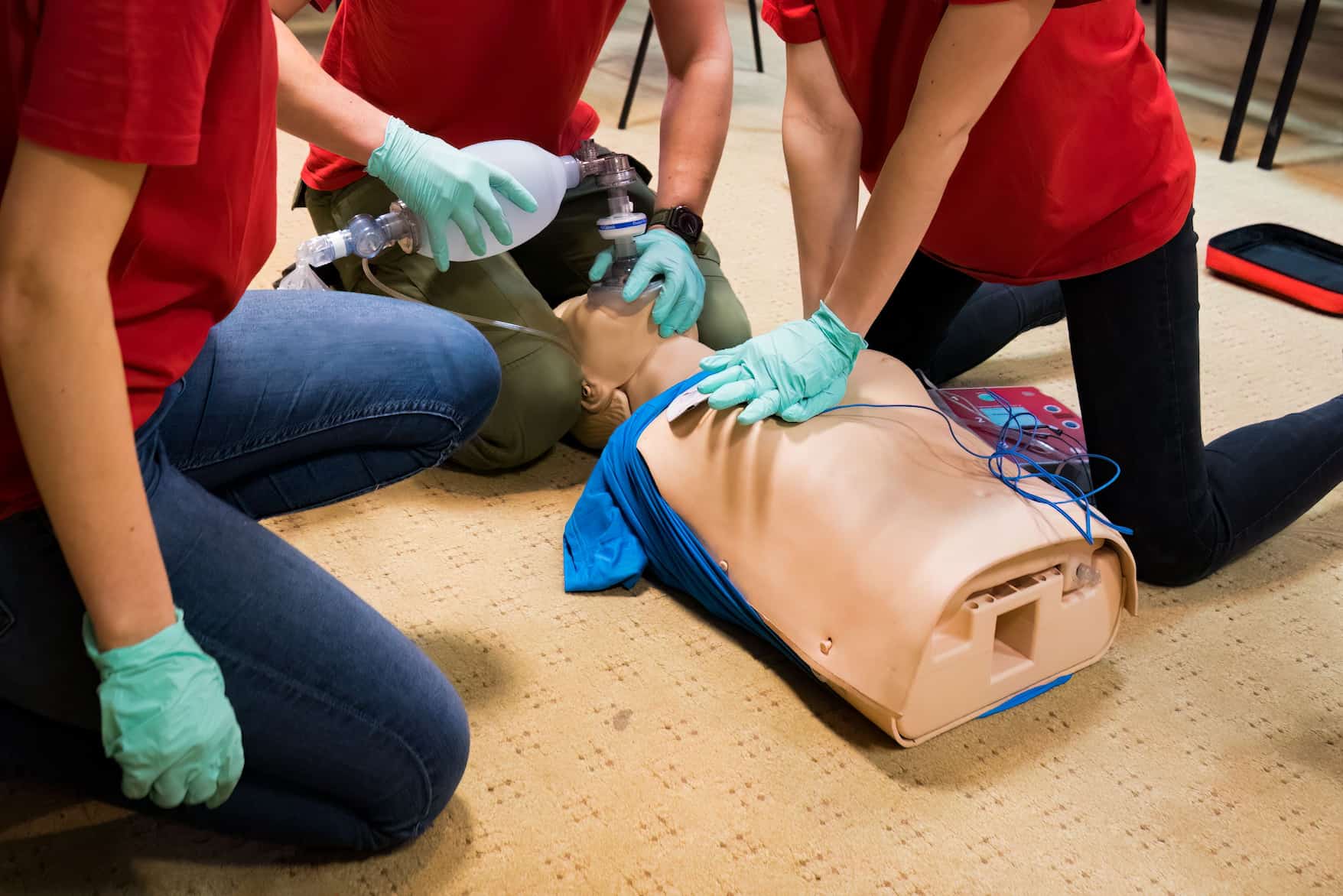
An authorized BLS training session provides hands-on, practical instruction that builds real confidence. The curriculum focuses on muscle memory so that you can react instantly under intense pressure. Here are the core competencies you will master during your classroom training session:
- High-Quality Adult, Child, and Infant CPR: You will learn correct hand placement, exact chest compression depth, and the precise rate of 100 to 120 compressions per minute.
- Automated External Defibrillator (AED) Operation: You will practice unboxing, powering on, and safely applying an AED to deliver a therapeutic shock during sudden cardiac arrest.
- Effective Bag-Mask Ventilation: Instructors teach you how to achieve a tight seal using a bag-mask device to deliver proper rescue breaths with minimal compression interruptions.
- Foreign Body Airway Obstruction Relief: You will master the specific techniques required to clear choking blockages in conscious and unconscious patients of all ages.
- Multi-Rescuer Team Dynamics: The class covers structured communication strategies and clear team roles to ensure highly coordinated resuscitation attempts.
Can I Take My Austin CNA CPR Certification Entirely Online?
The short answer is no. You cannot earn a compliant, employer-accepted CNA CPR certification through a purely online, text-based course. While many websites offer cheap, 100% online certifications, these programs are widely rejected by healthcare employers and state licensing boards.
Resuscitation requires manual dexterity and physical feedback that an online quiz cannot replicate. You must practice pushing to the correct depth on a physical manikin to truly understand the physical effort required. Employers know this, which is why human resources policies explicitly reject certificates that lack an in-person skills evaluation.
To guarantee your credential is valid, you must complete your live-training components in front of a certified instructor. In-person classes ensure your posture, depth, and timing are exactly where they need to be to save a real life.
How Long Does the In-Person BLS Certification Training Class Take?
Time is valuable when you are balancing long shifts at a care facility or completing your clinical hours. Fortunately, earning your professional credential does not require a massive time investment. An authorized American Heart Association BLS class is highly streamlined and efficient.
When you train at a professional local facility, the entire session takes approximately 3.7 hours to complete. Authorized training centers are legally required to show the entire instructional video and complete every practical testing module. The structured pacing keeps the class moving forward without any wasted downtime.
Because all your coursework, practicing, and testing are wrapped up in a single afternoon or morning block, you leave the facility completely finished. There are no take-home essays, additional online steps, or delayed grading windows to worry about.
How Much Does It Cost to Get CPR Certified in Austin?
Staying compliant with your professional certifications should not break your budget. Local training options are priced competitively to ensure healthcare students and working professionals can easily access top-tier education.
An official American Heart Association BLS CPR and AED certification class starts at a discounted rate of $64.95. This fee covers your seat in the class, your direct hands-on practice time with sanitarily maintained manikins, and your live skills assessment.
If your specific medical employer or nursing registry track requires a First Aid certification alongside your CPR credential, you can opt for a combined package. A comprehensive BLS CPR, AED, and First Aid course is available for $84.95. Investing in the official AHA track protects you from wasting money on unapproved, non-compliant courses.
When and How Will I Receive My Official Certification Card?
Waiting weeks for a paper certificate in the mail can delay your employment or put your current nursing shifts at risk. To eliminate this issue, modern certification uses a secure, digital verification system.
When you successfully complete your training with CPR Classes Near Me in Austin, your instructor processes your passing grade immediately. You will receive your official American Heart Association BLS eCard via email on the very same day you finish your class.
This digital card is completely secure, fraud-resistant, and OSHA-compliant. You can easily download a PDF copy for your personal records or forward the digital link directly to your facility’s human resources manager. It provides instant, undeniable proof of your compliance.
How Long Is a CNA BLS Certification Valid in Texas?
Your professional BLS credential remains active for exactly two years from the month it was issued. Once that twenty-four-month window closes, your card expires, and you are no longer legally permitted to work on a clinical floor as a CNA until you renew.
Because emergency medical guidelines change as new clinical data emerges, the AHA updates its training every few years. Keeping your certification cycle on a strict two-year timeline ensures that your clinical skills stay perfectly aligned with modern medical breakthroughs.
To prevent any lapses in your employment eligibility, it is smart to plan your renewal class roughly 30 days before your current card expires. This proactive approach ensures you never miss a shift or face administrative suspension from your nursing supervisor.
How Do I Renew My Expired or Expiring BLS Card in Austin?
If your current certification is nearing its expiration date, the renewal process is straightforward and stress-free. You do not need to hunt for a separate, shortened renewal track.
In the Austin area, the in-person BLS course and the renewal class are the exact same comprehensive session. This unified structure ensures that every returning student receives the exact same high-quality refresh on changing protocols, tool usage, and compression rhythms.
You will sign up for a standard local BLS time slot, practice your skills, complete the practical assessment, and walk away with a fresh two-year eCard on the same day. It is the fastest, most reliable way to extend your employment credentials for another twenty-four months.
Ready to Book Your Class? Secure Your Austin BLS Certification Today!
Don’t let an expired or missing credential hold back your healthcare career. Whether you are starting your very first nursing assistant job in downtown Austin or renewing your long-time credentials in Round Rock, we have you covered with fast, affordable, and fully compliant training.
Our expert instructors provide an engaging, supportive environment where you can build true lifesaving confidence. Best of all, you will walk out the door with your official, employer-accepted AHA eCard in hand on the exact same day.
Take the next step in protecting your patients and securing your clinical career. Contact CPR Classes Near Me today to check local schedules, look up convenient time slots, and lock in your seat for an upcoming certification session!
Frequently Asked Questions
What specific CPR card does a CNA need to work in an Austin hospital?
A Certified Nursing Assistant must hold an official American Heart Association (AHA) Basic Life Support (BLS) Provider card. General community or workplace CPR cards are not accepted in clinical hospital environments.
Can I use a 100% online CPR certificate for my Texas CNA license renewal?
No, Texas clinical facilities and the Nurse Aide Registry do not accept purely online CPR certificates. Your certification must include an in-person, hands-on skills verification conducted by a certified instructor.
What happens if my BLS certification expires while I am actively working as a CNA?
If your certification expires, you are technically out of compliance with state safety mandates. Your employer may legally suspend you from working shifts until you attend a class and earn a valid, active eCard.
Is there a minimum age requirement to take an AHA BLS class in Austin?
There is no formal minimum age restriction to earn an American Heart Association BLS certification. Anyone who can physically perform high-quality compressions and independently pass the skills test can get certified.
How much does a standard BLS class cost through CPR Classes Near Me in Austin?
A standalone, employer-accepted AHA BLS class costs $64.95. If you also need to add professional First Aid training to your credentials, the combined course is offered at a discounted rate of $84.95.