
Why Same-Day eCards Matter for Urgent Job Requirements
Landing a new job, locking in a promotion, or starting a clinical rotation is an exciting milestone. However, the excitement can quickly turn into anxiety when your employer tells you that you cannot step foot on the floor without a valid, compliance-approved Basic Life Support (BLS) certification. Even worse, you realize your previous certification expired last month, or a sudden policy change requires a specific credential by the start of next week. When you are up against a ticking clock, waiting weeks or even days for a physical certificate in the mail is not an option.
In modern professional settings, immediate proof of compliance is mandatory. This article explores how modern eCards solve the administrative bottlenecks of traditional certification. You will discover how swift credentialing impacts career advancement, why employers demand specific training standards, and how you can earn your official credential in a single afternoon.
What Is an American Heart Association (AHA) BLS eCard?
An American Heart Association (AHA) Basic Life Support (BLS) eCard is the official, fully digital alternative to the traditional printed paper or plastic certification wallet card. It serves as secure, verifiable evidence that an individual has successfully completed an in-person, instructor-led training session covering high-quality cardiopulmonary resuscitation (CPR) and the use of an Automated External Defibrillator (AED).
Historically, completing a life-saving course meant waiting for an administrative office to print, stamp, and mail a physical card. This manual workflow routinely delayed onboarding for days or weeks. The eCard ecosystem eliminates this lag. The digital document contains a unique credential ID and a scannable QR code. Employers, regulatory bodies, and human resource systems can instantly verify the authenticity of the certification through an online database, ensuring the worker is fully cleared for duty without administrative friction.
Why Is Same-Day Delivery Critical for Urgent Job Requirements?
For many professions, a valid BLS certification is not just a resume builder—it is a strict regulatory condition of employment. If you are a registered nurse, a certified nursing assistant (CNA), an emergency medical technician (EMT), or a childcare provider, working without an active card constitutes a major compliance violation. When a job offer or a shift assignment is contingent on immediate proof of compliance, same-day delivery prevents significant financial and professional setbacks.
A delayed certification can disrupt multiple industries in distinct ways:
- Healthcare Providers: Registered nurses, medical office personnel, and nurse practitioners face immediate suspension from clinical shifts or pushed-back start dates for new hospital contracts if cards lapse.
- Childcare Workers and Educators: Teachers and daycare personnel risk facility citations from state licensing boards or sudden loss of daily shift eligibility without active credentials.
- Fitness Professionals: Personal trainers and coaches risk immediate insurance policy invalidation and an inability to host training sessions at commercial gym spaces.
- Construction and Field Services: Industrial workers and electricians face immediate restriction from entering regulated or OSHA-monitored jobsites.
In competitive hiring environments, human resource departments move rapidly. If an onboarding coordinator has to choose between two equally qualified candidates, and one possesses a verified eCard while the other is waiting on a physical card in the mail, the job will almost always go to the compliant candidate. Same-day eCard delivery ensures you do not lose a career-defining opportunity simply because of administrative paperwork.
How Do Employers and Compliance Officers Verify Digital eCards?
With the rise of unaccredited online-only certificates, employers and compliance departments have become highly vigilant about credential verification. Fortunately, official digital credentials are designed to be tamper-proof and easily auditable.
When you complete your training with an authorized instructor, your eCard is issued directly through an authenticated portal. The digital certificate includes specific data points that allow risk managers and hiring coordinators to vet its validity within seconds:
- The Official Verification Portal: Employers can visit the central credential repository hosted by the training authority, where they enter your unique certificate number to see your active status.
- Direct QR Code Scanning: Most modern compliance officers use smartphones or tablets to scan the QR code printed on your digital layout, instantly opening the official verification database record.
- Tamper-Evident Meta Data: Unlike paper certificates that can be easily altered with editing software, an eCard links back to a secure, immutable database record that displays your exact exam date, instructor name, and training site details.
This rigorous level of security gives hospital systems, school districts, and corporate entities complete confidence when onboarding new staff on short notice.
Why Do Employers Reject 100% Online CPR Certifications?
When time is short, it can be incredibly tempting to register for a cheap, 100% online course that promises a print-at-home certificate in fifteen minutes. However, doing so is highly likely to result in your application being rejected by human resources.
The vast majority of employers, state licensing boards, and federal agencies like the Occupational Safety and Health Administration (OSHA) maintain strict mandates requiring an in-person, hands-on skills assessment. Life-saving techniques require precise physical application—such as achieving the correct compression depth, maintaining a rate of 100 to 120 compressions per minute, and properly configuring an AED.
An online quiz cannot evaluate whether your hands are placed correctly on a manikin’s chest, nor can it correct your form if your chest recoils are incomplete. Sites that claim to offer full online certification often hide the fact that they lack official alignment in their fine print. Investing time and money into a non-compliant online course usually means you will have to repeat the entire process in an authorized, face-to-face environment to satisfy your employer’s safety mandates.
What Lifesaving Skills Are Taught in a High-Quality BLS Class?
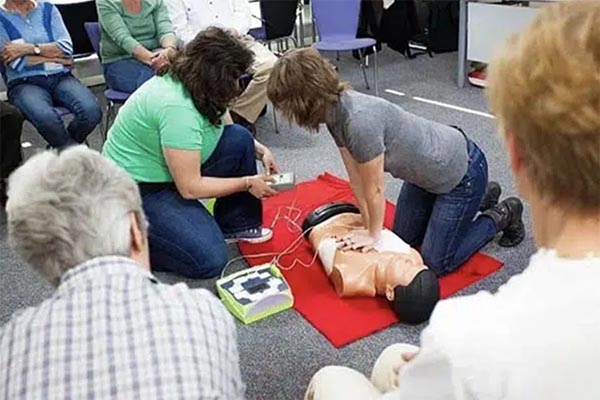
An authorized, comprehensive BLS training session is structured to ensure that you can act with absolute confidence during a high-stress medical emergency. Over the course of an interactive session lasting approximately 3.7 hours, expert instructors guide you through real-world emergency scenarios using physical manikins and live trainer equipment.
The comprehensive curriculum includes several core modules required for professional compliance:
High-Quality CPR for Adults, Children, and Infants
You will master the foundational mechanics of chest compressions and rescue breaths across different age brackets. Instructors provide real-time feedback on your hand positioning, body mechanics, compression depth, and compression rates to guarantee that your efforts effectively circulate oxygenated blood to vital organs.
Automated External Defibrillator (AED) Implementation
An AED is a critical tool for surviving sudden cardiac arrest. In your class, you will practice unboxing, powering on, placing pads, and safely delivering a shock using real-world AED simulators. You will learn how to seamlessly integrate an AED into your ongoing CPR cycles with minimal disruption.
Advanced Ventilation and Bag-Mask Techniques
Healthcare environments and multi-rescuer responses frequently require specialized ventilation equipment. The class covers how to assemble and utilize pocket masks and bag-mask devices to deliver effective rescue breathing, ensuring that airway management remains steady and structured.
Relief of Choking and Airway Obstructions
When a foreign object cuts off someone’s airway, every second matters. The training covers how to recognize the distinct signs of choking and how to safely execute abdominal thrusts (the Heimlich maneuver) or back blows on adults, children, and infants.
Team Dynamics and Coordinated Response
In a real-world emergency, multiple people often respond at once. You will practice communication strategies and defined team roles, learning how to coordinate smoothly with other rescuers to minimize interruptions in chest compressions.
How Long Does the In-Person Certification Process Take?
Many busy professionals put off their certification because they assume it will take up an entire weekend. In reality, the entire process is streamlined to respect your schedule while delivering elite-tier training.
A standard, authorized in-person class takes roughly 3.7 hours to complete from start to finish. During this single afternoon or morning block, you will watch the required instructional videos, complete your hands-on practice, ask clarifying questions, and undergo your final practical evaluation.
Because authorized training sites utilize structured lesson plans and efficient instructor-to-student ratios, there is zero wasted time. As soon as your instructor confirms that your practical skills meet the strict performance metrics, they can log into the electronic system and issue your eCard before you even walk out the front door.
What Long-Term Benefits Do You Get From an Active Certification?
While an urgent job requirement might be the immediate catalyst forcing you to sign up for a class, maintaining an active credential provides lasting professional and personal advantages:
- Two Years of Universal Compliance: Once successfully issued, your official BLS certification remains fully active and compliant for two entire years. You will not have to worry about sudden compliance checks or missing out on temporary shifts.
- Broader Career Flexibility: Many healthcare agencies, school systems, and rescue organizations require workers to step in across various departments or locations. Possessing a universally accepted credential means you are always eligible for cross-training or rapid relocation.
- Real-World Confidence: Beyond the professional paperwork, you gain the undeniable peace of mind that comes with knowing exactly what to do if a family member, co-worker, or stranger suffers a sudden cardiac event in your presence.
Ready to Secure Your Same-Day eCard?
Don’t let an unexpected compliance deadline or a sudden job requirement stall your professional momentum. Whether you need an immediate renewal or are certifying for the very first time, our elite team of certified instructors is here to provide an engaging, stress-free, and compliant learning environment.
We offer flexible morning, evening, and weekend schedules tailored around busy professionals. Walk away with the skills to save a life and the official, employer-accepted eCard you need today.
Contact CPR Classes Near Me today to check local seat availability, view upcoming class times, and secure your spot in an upcoming session!
Frequently Asked Questions
How do I get CPR certified?
To earn your official certification, you must attend an authorized, in-person training class. During the session, you will participate in live-training exercises, practice techniques on specialized manikins, learn to operate an AED, and pass a practical evaluation led by a certified instructor.
How much does professional training cost?
At our dedicated training locations, an official BLS CPR & AED class is priced at $64.95, while a combined CPR, AED, and First Aid class is available for $84.95. Be cautious of extremely cheap online options, as they routinely lack the official credentials demanded by employers.
How long does a CPR certification last?
Upon successful completion of your in-person class and skills assessment, your certification is valid for exactly two years. To maintain your compliant status, you must complete a standard renewal course before your current two-year window expires.
Can I renew an expired CPR certification?
Yes. If your current certification is nearing its expiration date or has recently lapsed, you can enroll in a standard BLS course to extend your valid status for another two years. The comprehensive in-person curriculum serves perfectly for both first-time students and renewing professionals.
Who is eligible to take a professional CPR class?
Anyone who is physically capable of performing independent chest compressions and following safety commands can take a class. There is no minimum age requirement, making the course ideal for healthcare workers, educators, students, and safety-conscious community members alike.
Can I complete my official CPR certification entirely online?
No. To satisfy professional workplace compliance and OSHA requirements, your certification must include an in-person, hands-on skills evaluation. Employers almost universally reject certificates obtained through online-only courses that lack face-to-face instruction.
When will I receive my digital certification card?
When you train at our facilities, your instructor will issue your official digital eCard on the exact same day you complete your class. You will receive an electronic notification allowing you to download, print, or email your credentials to your employer immediately.