Why Healthcare Workers Usually Need BLS Instead of Basic CPR
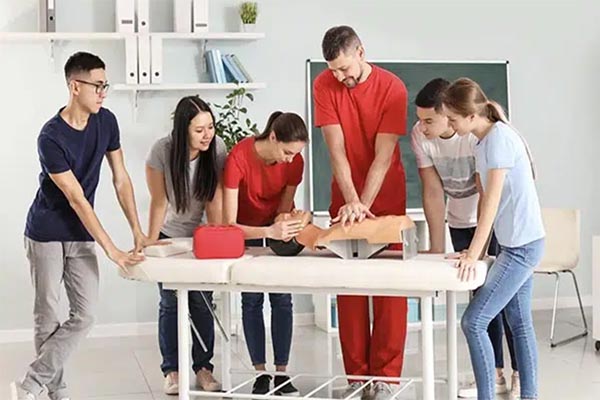
First aid instructor teaching CPR to a group of students using a practice mannequin.

If you work in healthcare, you have likely received a checklist of onboarding requirements from your employer. Near the top of that list is almost certainly a demand for a current life-saving credential. However, if you sign up for a standard, community-level CPR class, you might find yourself turned away on your first day of clinical orientation.

Understanding the differences between BLS vs basic CPR is crucial for maintaining your professional credentials. While both courses teach how to respond to cardiac arrest, they are designed for entirely different audiences, environments, and situations.

At CPR Classes Near Me, we frequently help nurses, therapists, and dental professionals navigate these class types to ensure they get the exact certification they need to work. Let’s break down exactly why clinical settings demand a more advanced level of training.

What is the Core Difference Between BLS vs Basic CPR?

At its simplest, Basic Life Support (BLS) is a specialized class designed for medical professionals, whereas basic CPR is geared toward laypeople. A standard CPR course (often labeled as “Heartsaver”) teaches single-rescuer techniques, basic automated external defibrillator (AED) use, and choking relief. It is perfect for teachers, fitness coaches, and construction workers who may need to act before paramedics arrive.

In contrast, an American Heart Association BLS course is structured specifically for clinical environments. It assumes you will be working alongside other trained professionals as part of a highly coordinated team. BLS covers multi-rescuer resuscitation, advanced airway techniques, and rapid physical assessments that are not taught in basic layperson classes.

Why Do Employers Require BLS for Clinical Environments?

Hospitals, outpatient clinics, and nursing facilities require BLS because they operate under a higher standard of care. If a patient collapses in a hospital hallway, the response is rarely a single person acting alone. It is an immediate team effort involving nurses, doctors, and technicians who must assign and execute specific roles.

BLS teaches healthcare workers how to manage these rapid team dynamics. It covers how to cycle through chest compressions to prevent fatigue, how to assign a team leader, and how to communicate clearly under stress. Basic CPR classes simply do not provide the team-focused training required to coordinate a multi-person rescue effort in a clinic.

What Advanced Techniques Are Only Taught in BLS Classes?

The clinical depth of BLS includes several technical procedures that laypeople are not trained to perform. These skills require specialized medical equipment commonly found in clinical crash carts.

Here are the key technical skills unique to a healthcare provider BLS course:

  • Pulse Checks: BLS students are trained to perform rapid, simultaneous pulse and breathing checks (taking no more than 10 seconds) on the carotid or brachial artery. Basic CPR classes teach laypeople to look only for “signs of life” or normal breathing to keep the process simple.
  • Bag-Mask Ventilation: Medical professionals must know how to use a bag-valve-mask (BVM) to deliver positive-pressure ventilation. This requires mastering the “E-C clamp” technique to create a tight seal over the patient’s face, a skill not taught in community CPR.
  • Advanced Airway Integration: BLS training covers how to coordinate chest compressions when an advanced airway (such as an endotracheal tube or supraglottic device) is in place, transitioning from cycles of 30:2 to continuous compressions with a breath every 6 seconds.
  • Two-Rescuer CPR Ratios: Healthcare workers learn specific compression-to-ventilation ratios that change based on the number of rescuers and the age of the patient (such as a 15:2 ratio for two-rescuer infant CPR).

How Do Licensing Boards and Hospital Guidelines Enforce This?

State licensing boards, professional associations, and healthcare employers almost universally require an American Heart Association (AHA) BLS certification. These organizations must comply with strict national standards, such as those set by the Occupational Safety and Health Administration (OSHA) and Joint Commission hospital accreditation rules.

Because community-level CPR courses do not cover advanced airway management or professional team dynamics, they do not meet clinical compliance standards. Presenting a layperson CPR card to a hospital credentialing specialist will result in immediate rejection, potentially delaying your start date or leading to shifts missed.

Can Healthcare Workers Take Their BLS Training Online?

While many online companies advertise fast, fully digital BLS certifications, employers and licensing boards rarely accept them. The AHA and major healthcare networks require an in-person, hands-on skills assessment to verify your technique.

During a hands-on BLS class with CPR Classes Near Me, an instructor directly evaluates your compression depth, compression rate, and bag-mask ventilation technique. This physical verification ensures you can perform high-quality life-saving skills on a real patient. A fully online course cannot replicate this hands-on feedback, which is why in-person or hybrid (online lecture with in-person skills check) classes remain the industry gold standard.

Get Your Official AHA BLS Certification Today

Don’t let an expired or incorrect credential stall your medical career. At CPR Classes Near Me, we offer fully accredited American Heart Association BLS classes designed to fit your busy shifts. Our local, hands-on courses are led by experienced instructors who make sure you walk out with the practical skills and confidence you need in a clinical emergency.

Best of all, we issue your official American Heart Association BLS eCard on the very same day you complete your training.

If you are ready to renew your credentials or earn your first clinical life support certification, contact CPR Classes Near Me today to find a class time that fits your schedule!

Frequently Asked Questions

Is BLS harder to pass than basic CPR?

While BLS covers more advanced clinical scenarios and equipment, the material is highly accessible. The course is designed to be supportive and educational. With our experienced instructors, you will have plenty of hands-on practice to master the techniques before your evaluation.

How long does a healthcare provider BLS certification last?

An official American Heart Association BLS certification is valid for two years from the date of your class. You will need to take a BLS renewal class before your current card’s expiration date to maintain active credentials.

Does BLS cover infant and child CPR?

Yes. BLS training includes complete modules for high-quality CPR, choking relief, and AED use for adults, children, and infants, with specific techniques for both single-rescuer and multi-rescuer scenarios.

Can I use a BLS card if a job only asks for basic CPR?

Yes, BLS is a higher-level certification. If an employer or volunteer group only requires basic CPR, they will gladly accept a valid BLS card because it demonstrates a higher level of life-saving proficiency.

What should I bring to my in-person BLS class?

You only need to bring comfortable clothing that allows you to move freely, as you will be practicing compressions on floor-level and table-level manikins. All training materials, barrier devices, and feedback equipment are provided at our training center.
CPR Certification for Dental Assistants and Dental Offices: The Complete Compliance Guide

When a medical emergency occurs in a dental office, every second counts. Patients undergoing dental treatments can experience sudden cardiac arrest, severe allergic reactions, or respiratory distress right in the chair. To handle these high-stress situations, dental practices must act as cohesive, rapid-response teams.

This is why having a current CPR Certification for Dental Assistants and Dental Offices is a non-negotiable standard of care. It ensures that every team member, from the clinical staff to the front desk, can step in to save a life.

In this comprehensive guide, we will break down the exact training mandates, explore state board compliance standards, and show you how to get certified.

Why Is CPR Certification for Dental Assistants and Dental Offices Mandatory?

Dental settings present unique physiological stressors for patients. The combination of dental anxiety, local anesthetics, invasive procedures, and pre-existing medical conditions can trigger life-threatening events. Studies show that syncope (fainting), hyperventilation, and adverse drug reactions are surprisingly common in dental operatories.

If a patient’s heart stops or they stop breathing during a procedure, the dentist cannot handle the emergency alone. The entire clinical team must coordinate immediately to perform high-quality resuscitation and operate emergency equipment.

State dental boards and national organizations like the Dental Assisting National Board (DANB) mandate active CPR credentials to protect public safety. Maintaining your team’s certification is also a key factor in keeping your dental malpractice insurance valid.

What Level of CPR Certification Do Dental Offices Need?

Not all CPR courses are created equal. While general public or “layperson” CPR courses are excellent for families or retail workers, they do not meet the legal requirements for dental professionals.

Dental offices require a healthcare-grade certification, typically referred to as Basic Life Support (BLS). This curriculum is specifically designed for individuals working in clinical environments.

Dentists, hygienists, and dental assistants must obtain this professional BLS certification. The program is certified by recognized bodies like the American Heart Association (AHA) or the American Red Cross and covers multi-rescuer CPR, bag-valve-mask use, and advanced airways.

For the non-clinical front desk and administrative staff, a standard adult and pediatric CPR and AED certification is highly recommended to ensure the entire office can respond during an emergency.

How Does Basic Life Support (BLS) Training Differ From Standard CPR?

Standard CPR focuses on single-rescuer scenarios using minimal equipment. In contrast, professional BLS training is built for a team-based medical environment. It assumes you have access to professional emergency tools, such as barrier devices, oxygen equipment, and advanced airway adjuncts.

Key training differences include:

  • Bag-Valve-Mask (BVM) Ventilation: Learning how to seal and compress a BVM device to deliver oxygenated breaths with two-person coordination.
  • Pulse Checks: Quickly and accurately identifying a pulse in adults, children, and infants in under 10 seconds.
  • Multi-Rescuer Team Dynamics: Practicing structured roles (compressor, ventilator, AED operator) to minimize interruptions in chest compressions.
  • Advanced Airways: Safely administering rescue breaths when a patient has an advanced airway tube in place.

Understanding these advanced concepts ensures your team can seamlessly assist emergency medical services (EMS) when they arrive on the scene.

What Does a Hands-on Dental CPR Training Session Entail?

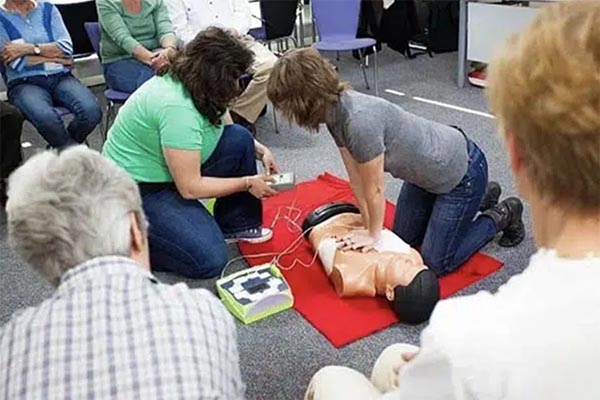
While online modules are great for learning medical theory, they cannot teach the muscle memory required to save a life. A proper hybrid or fully in-person class features structured, hands-on practice led by a certified instructor.

During your training session, your staff will practice:

  • High-Quality Chest Compressions: Achieving a depth of at least two inches on adults and a rate of 100 to 120 compressions per minute.
  • AED Placement and Safety: Properly applying electrode pads, letting the machine analyze the heart rhythm, and clearing the patient before a shock is delivered.
  • Choking Relief: Clearing foreign body airway obstructions in conscious and unconscious victims of all ages.
  • Pediatric Resuscitation: Adapting compression depths and rescue breathing ratios for pediatric dental patients.

How Often Must Dental Office Staff Renew Their CPR Certification?

A standard BLS or healthcare CPR certification is valid for two years from the date of course completion. Once this period expires, you must complete a renewal course to maintain your active credentials.

Skill decay is a serious concern in the medical community. Research indicates that CPR psychomotor skills begin to deteriorate as early as three to six months after initial training.

Waiting longer than two years to refresh your skills can leave your team underprepared during a real crisis. Many forward-thinking dental practices host annual, in-office refresher sessions to keep emergency protocols fresh.

Can You Get Certified Through an Online-Only CPR Course?

The short answer is no. Most state dental boards and credentialing organizations like DANB strictly reject 100% online CPR certificates. They require a live physical skills assessment verified by a certified instructor.

However, you can take advantage of blended learning options. This hybrid format allows your dental staff to complete the classroom and cognitive portions online at their own pace.

Once completed, you simply schedule a quick, 30-to-45-minute in-person skills check to verify compression depth, ventilation technique, and AED usage on a smart manikin. This approach minimizes office downtime while fully satisfying state board requirements.

How Many Continuing Education (CE) Credits Do Dental Professionals Earn?

Because BLS is a professional development requirement, most accredited training providers offer Continuing Education (CE) credits upon completion. These credits can be applied directly toward your state license renewal cycle.

Typically, a standard healthcare provider CPR or BLS course awards 2 to 4 CE hours. If you opt for a comprehensive combination course that integrates basic first aid alongside CPR, you can earn up to 6 CE hours.

Always verify that your training center is approved by the Academy of General Dentistry (AGD) PACE program or your local state dental board to guarantee your CE hours will count.

Make Safety Your Practice’s Priority

Maintaining your dental office’s emergency readiness is a regulatory necessity and a moral obligation to your patients. Investing in regular, high-quality CPR training protects your dental assistants’ credentials, fulfills licensing board mandates, and builds trust with your community.

Ready to get your team certified or looking to renew your expired credentials? We specialize in flexible, hands-on BLS training programs tailored specifically for busy dental practices.

Contact CPR Classes Near Me today to schedule your next group class or individual skills check!

Frequently Asked Questions

Do dental assistants need CPR certification?

Yes, dental assistants must maintain an active CPR or Basic Life Support (BLS) certification to fulfill state licensing requirements and maintain professional credentials like those from the Dental Assisting National Board (DANB).

Which CPR certification is accepted by state dental boards?

Most state dental boards require a healthcare-grade Basic Life Support (BLS) certification that includes a live, in-person hands-on skills evaluation. Courses certified by the American Heart Association (AHA) or American Red Cross are universally accepted.

How long is a dental office CPR certification valid?

A standard BLS and CPR certification is valid for exactly two years. Dental professionals must take a renewal course before their current card’s expiration date to avoid compliance gaps.

Can dental offices use 100% online CPR courses?

No, 100% online courses are generally rejected by licensing boards because they lack a hands-on physical skills assessment. However, blended learning courses that feature an online lecture followed by a brief in-person skills check are widely accepted.

What is the penalty for letting dental CPR certifications expire?

Practicing with an expired CPR certification can lead to fines from your state dental board, the suspension of your clinical license, and the denial of malpractice insurance claims if an emergency occurs.