
CPR for School Coaches and Athletic Staff: The Ultimate Safety & Compliance Guide
Every season, millions of student-athletes take to fields, courts, tracks, and pools across the country. As a coach or athletic team staff member, your influence extends far beyond playbook strategy and athletic performance. You are the first line of defense when a medical crisis occurs during practice or competition.
When sudden cardiac arrest strikes on the playing field, seconds count. Knowing how to administer CPR for school coaches and athletic staff isn’t just a regulatory checkbox—it is a life-saving skill set that keeps sports programs safe, compliant, and prepared.
This guide explores why CPR and AED training are vital for school athletic personnel, what specific skills sports staff need to master, and how your athletic department can get certified quickly through official American Heart Association (AHA) training.
Sudden Cardiac Arrest in Student Athletes Demands Immediate Action
Sudden cardiac arrest (SCA) remains the leading cause of natural death in young athletes during physical exertion. While sports offer immense physical and mental benefits, high-intensity exercise can trigger underlying, undetected cardiac conditions such as hypertrophic cardiomyopathy or commotio cordis.
Because coaches, trainers, and referees are often nearest to the action, their immediate reaction determines whether a student survives. Having trained athletic personnel on the sidelines bridges the critical gap between collapse and the arrival of emergency medical service (EMS) professionals.
Why is CPR training mandatory for school coaches and athletic staff?
Most state athletic associations, school boards, and state departments of education legally require all head coaches, assistant coaches, and athletic directors to maintain current CPR and First Aid certification. These legal regulations exist because athletic activity inherently increases physical strain and risk of acute injury or collapse.
Beyond regulatory mandates, school districts owe a duty of care to student-athletes and spectators. Having certified athletic personnel minimizes organizational liability while fostering a culture of safety across all campus athletic facilities.
How does quick action by athletic staff save young lives on the field?
When cardiac arrest occurs, brain tissue begins suffering permanent damage within four to six minutes without oxygenated blood flow. Effective CPR manually pumps blood through the heart to critical organs, preserving vital tissue while an AED is fetched.
Studies consistently show that immediate CPR combined with defibrillation within three minutes raises youth cardiac arrest survival rates to over 70%. When coaches recognize collapse immediately and start compressions without hesitation, they directly save lives.
Essential CPR and AED Skills Every Athletic Department Must Master
Responding to a medical emergency during a high-stakes athletic event involves unique challenges, such as crowd noise, intense emotional atmosphere, heavy protective gear, and physical distance from medical rooms. Athletic personnel require practical, hands-on training tailored to real-world scenarios.
Through hands-on CPR classes, coaches build the muscle memory necessary to remain calm, focused, and decisive during a high-pressure incident.
The athletic emergency response chain relies on four clear, consecutive actions:
- Recognize Unresponsiveness: Identify collapse quickly and look for absence of normal breathing.
- Call 911 & Retrieve AED: Direct a specific bystander or assistant to contact emergency services and grab the nearest AED unit.
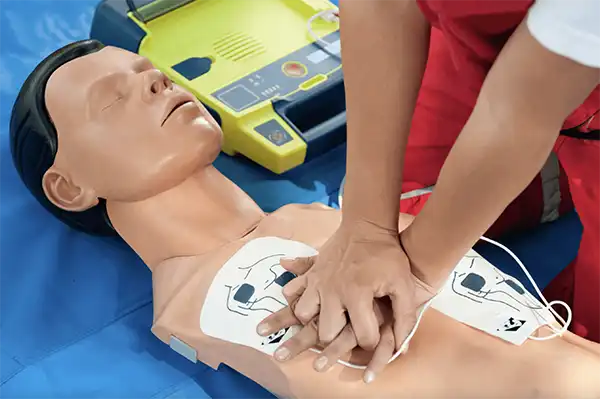
- Start CPR Compressions: Deliver hard and fast compressions at a rate of 100 to 120 beats per minute, pushing at least 2 inches deep.
- Apply AED Pads: Open the defibrillator, attach pads to the athlete’s bare chest, and follow the unit’s automated voice prompts.
What is the difference between standard CPR and athletic field emergency response?
Standard CPR focuses on general chest compressions and rescue breaths for adult or child victims in routine settings. Athletic emergency response must adapt those core mechanics to sports-specific obstacles.
For example, athletic staff must quickly assess whether padding or helmets need removal to access the chest or manage airway access safely. Coaches must also know how to coordinate crowd control and assign specific duties to assistant coaches or student managers in seconds.
How should coaches properly operate an Automated External Defibrillator (AED)?
An Automated External Defibrillator (AED) is a user-friendly device designed to analyze heart rhythms and deliver a precise electric shock if a shockable rhythm is detected. During an emergency, athletic staff should open the AED, power it on, and follow the clear voice and visual prompts provided by the unit.
Coaches must quickly clear sweat or water from the athlete’s chest, apply the self-adhesive pads correctly, and ensure no one is touching the victim while the unit analyzes or delivers a shock. Operating an AED alongside continuous high-quality chest compressions provides the highest chance of restoring normal heart rhythm.
What are the key steps for pediatric and adult CPR during sports emergencies?
High school athletes generally follow adult CPR algorithms, while middle school and youth sports participants may require pediatric adaptations depending on physical development.
- Check for Responsiveness & Breathing: Tap the athlete’s shoulders firmly and shout loudly. Look for normal breathing; irregular gasping is not normal breathing and requires immediate action.
- Activate EMS and Get the AED: Point directly at an assistant, trainer, or spectator and say, “Call 911 and bring me the nearest AED immediately!”
- Deliver High-Quality Compressions: Place the heel of one hand in the center of the chest with the other hand laced on top. Compress hard and fast at a rate of 100 to 120 compressions per minute at a depth of at least 2 inches for adults and older teens.
- Provide Rescue Breaths: Give 2 rescue breaths after every 30 compressions if trained, ensuring the chest visibly rises with each breath.
- Attach and Follow AED Instructions: Apply AED pads as soon as the unit arrives, resume compressions immediately after shocks, and continue until EMS arrives.
Legal Requirements, State Regulations, and Athletic Compliance
School administrators and athletic directors face rigorous compliance standards governed by state legislation, state high school athletic associations, and local school board policies. Staying up to date on certification requirements prevents compliance gaps and keeps teams eligible to compete.
Which CPR certifications do school districts and athletic associations require?
Most athletic governing bodies require American Heart Association (AHA) Basic Life Support (BLS) or AHA CPR and First Aid certifications. Online-only courses are rarely accepted by school districts or legal regulatory bodies because they lack hands-on skills verification.
Hands-on training ensures that coaches demonstrate correct hand placement, compression depth, compression rate, and proper AED pad placement in front of a certified instructor.
How often do sports coaches need to renew their CPR and First Aid eCards?
Official AHA CPR and First Aid eCards remain valid for two years from the issue date. To maintain continuous athletic compliance, coaches and sports staff should schedule renewal classes prior to the expiration month listed on their digital eCard.
Renewing your certification every two years keeps life-saving protocols fresh in your mind while introducing updated science and emergency guidelines from the AHA.
Implementing Emergency Action Plans (EAPs) for Athletic Programs
Having certified staff is only one piece of effective athletic emergency readiness. Athletic departments must build comprehensive, facility-specific Emergency Action Plans (EAPs) that dictate exact steps for every venue, including gymnasiums, football stadiums, practice fields, and off-site venues.
To ensure venue readiness across all campus sports facilities, every athletic director should verify the following baseline requirements:
- AED locations are clearly marked, accessible, and unlocked during practices and games.
- Designated personnel are assigned to unlock facility gates and guide incoming EMS vehicles.
- Direct radio or cellular communications are operational on all outdoor practice fields.
- Facility keys are accessible for locked gates or stadium entrances.
- Annual emergency rehearsals are completed with all head coaches, assistants, and trainers.
How do coaches integrate CPR skills into a school’s Emergency Action Plan?
Coaches integrate CPR skills into an EAP by rehearsing exact emergency scenarios before the sports season begins. Each coach, athletic assistant, and student trainer must know their designated role during an incident.
One person begins CPR immediately, a second person retrieves the nearest AED, a third person calls 911 and contacts campus administrators, and a fourth person meets arriving paramedics at the venue entrance gate. Rehearsing these steps eliminates confusion when every second counts.
What role does group CPR training play in team and school staff safety?
Group CPR training allows an entire coaching department, physical education faculty, or athletic league to complete certification simultaneously. Training as a team builds smooth communication, shared vocabulary, and seamless coordination during crisis situations.
Off-site or on-site group training makes scheduling convenient for busy athletic departments preparing for upcoming fall, winter, or spring seasons.
Choosing the Right AHA-Aligned CPR Certification Course
When selecting a CPR training provider for athletic personnel, school administrators and coaches should prioritize convenience, employer acceptance, and high-quality instruction.
Can school coaches complete CPR certification in a single hands-on session?
Yes, complete hands-on CPR and First Aid training can be finished in a single, efficient session lasting approximately 3 to 4 hours. You receive immediate, interactive instruction, practice on specialized training mannequins, and undergo real-time skills evaluations.
Upon successfully passing the class, your instructor issues an official AHA eCard on the same day, allowing you to submit proof of certification to your school district immediately.
Why do employers and school districts insist on American Heart Association hands-on training?
The American Heart Association sets the global gold standard for resuscitation science and cardiovascular emergency care. AHA certifications are universally recognized by school districts, state athletic associations, healthcare organizations, and government agencies nationwide.
Hands-on practice ensures that participants develop accurate physical coordination and spatial confidence—something static online videos simply cannot replicate.
Keep Your Athletes Safe with Professional CPR Certification
As a school coach, referee, or athletic director, your dedication shapes young lives both on and off the field. By mastering high-quality CPR and AED techniques, you ensure that your players train and compete in a safe environment backed by expert emergency response skills.
Don’t wait for the sports season to begin to check your certification status. CPR Classes Near Me provides top-rated, official American Heart Association CPR, AED, and First Aid certification classes designed for coaches, teachers, and school athletic departments. Enjoy convenient class schedules, hands-on practice with certified instructors, and same-day eCard delivery.
Ready to protect your athletes and ensure athletic department compliance? Contact CPR Classes Near Me today to schedule your individual class or arrange group training for your entire coaching staff!
Frequently Asked Questions
Is online-only CPR certification accepted for school coaches?
No, virtually all school districts and state athletic associations require hands-on skills verification for CPR certification. Online-only courses lack practical mannequin practice and are generally rejected during compliance checks. Official American Heart Association classes include mandatory in-person skills practice.
How long does a CPR certification class take for school coaches?
An in-person AHA BLS CPR or CPR and First Aid class typically takes about 3.5 to 4 hours to complete. Instructors guide you through instructional videos, physical technique practice, AED operation, and a brief skills check. You receive your official certification eCard the exact same day.
Which CPR course should high school coaches take?
High school coaches typically need either the AHA Basic Life Support (BLS) course or the AHA Heartsaver CPR, AED, and First Aid course, depending on school district requirements. Both courses cover adult and pediatric CPR, AED usage, and choking relief. Always check with your athletic director to confirm the exact credential required by your district.
How often must coaches renew their CPR certification?
CPR certification eCards issued through the American Heart Association are valid for two years. Athletic staff must complete a renewal course every two years before the expiration date to remain compliant with state regulations and school board policies.
Can athletic departments schedule group CPR training for coaches on campus?
Yes, group CPR training can easily be arranged for entire athletic departments, coaching staffs, or school faculties. Instructors bring all required training mannequins, AED simulators, and course materials directly to your facility or host your group at a local training center.
Does athletic CPR training cover both adult and pediatric guidelines?
Yes, standard AHA CPR courses cover techniques for adults, children, and infants. High school coaches learn adult CPR protocols, while middle school and youth sports coaches learn pediatric variations to accommodate younger student-athletes.