What School Administrators Should Look for in CPR Training: A Complete Buyer’s Guide
As a school administrator, ensuring the safety and well-being of hundreds—or even thousands—of students and staff members rests on your shoulders. When a medical emergency occurs on campus, there is no time to wait for external first responders. The immediate actions of teachers, coaches, and staff during those first critical minutes determine the outcome.
Selecting the right provider for CPR training for school administrators and campus staff is far more than a routine compliance checkbox. It is an investment in campus safety, risk management, and legal preparedness. However, with dozens of training options available, identifying high-quality instruction that fits your district’s schedule and budget can be challenging.
In this guide, we break down exactly what educational leaders should evaluate when choosing a CPR training partner. You will learn how to verify credentials, ensure hands-on mastery, streamline group logistics, and maintain full compliance with state and national standards.
What Certification Standards Should School Administrators Prioritize?
When reviewing CPR training programs, the governing body issuing the credentials is your most important consideration. Not all CPR cards carry equal weight, and opting for an unaccredited course can leave your district vulnerable to compliance penalties and liability risks.
School districts must prioritize training aligned with the American Heart Association (AHA). The AHA sets the gold standard for resuscitation science in the United States. Its Basic Life Support (BLS) and Heartsaver protocols are recognized nationwide by state departments of education, OSHA, and risk management insurers.
Choosing official AHA-aligned courses guarantees that your staff learns updated, evidence-based techniques. Unaccredited online-only courses often promise quick results at low costs, but they rarely meet state educational mandates or employer acceptance requirements. Always ensure your training provider provides official AHA eCards upon completion.
Why Is Hands-On Practice Essential for School Staff CPR Training?
While theoretical knowledge is valuable, true emergency preparedness requires physical muscle memory. In a high-stress scenario—such as a student collapsing in the gymnasium or choking in the cafeteria—reading about CPR is not enough to ensure effective intervention.
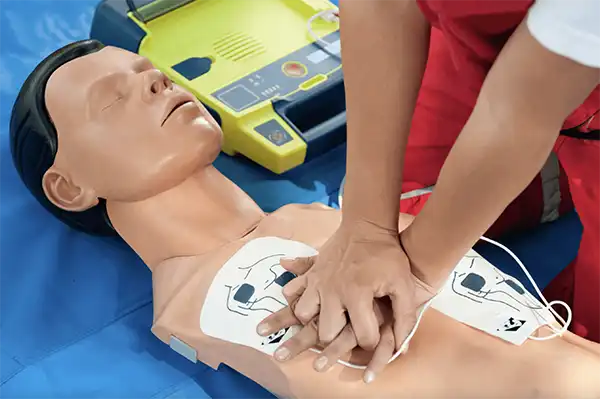
Comprehensive school CPR certification must include structured, hands-on practice using realistic training equipment. Your chosen training partner should supply adequate equipment for all participants, including specialized devices that ensure practical mastery.
Feedback manikins provide real-time visual or audio guidance on compression depth and rate, keeping compressions within the recommended target of 100 to 120 beats per minute. Pediatric and infant manikins allow staff to practice proper finger placement and adjusted force for younger age groups. Additionally, AED trainers guide staff through pad placement, device prompts, and safety clearance steps in a controlled setting.
Hands-on instruction ensures that staff members leave the classroom feeling confident in their ability to execute life-saving chest compressions, operate an AED safely, and perform rescue breaths under pressure.
How Does Pediatric CPR Training Differ from Adult Protocols for Schools?
A primary challenge in educational settings is that school personnel interact with individuals across a broad age spectrum. A high school teacher might need to assist a 17-year-old student or an adult colleague, while an elementary or pre-K teacher works primarily with young children and toddlers.
Effective group CPR classes for schools must thoroughly address adult, child, and infant CPR techniques. The physiological differences between these groups significantly alter emergency protocols.
For adults, compressions require two hands at a depth of at least 2 inches. Child compressions may use one or two hands at about 2 inches, while infant compressions require two fingers or two thumbs at a depth of 1.5 inches. Choking interventions also vary, moving from abdominal thrusts for conscious adults and children to back slaps and chest thrusts for infants.
Furthermore, children and infants frequently experience cardiac arrest due to respiratory failure rather than primary cardiac events. This makes prompt, accurate rescue breathing especially critical for pediatric age groups. Ensure your training provider offers comprehensive instruction covering all age demographics relevant to your campus.
What On-Site Group Training Options Are Best for School Districts?
Coordinating professional development for dozens or hundreds of educators across multiple school buildings is a significant administrative hurdle. Requiring teachers to travel individually to off-site testing facilities causes scheduling conflicts and balloons travel expenses.
The most efficient solution is on-site school staff CPR training. Reputable training centers bring all necessary equipment—manikins, AED trainers, and instructional materials—directly to your campus. This approach offers several distinct operational benefits.
First, it allows for customized scheduling during teacher in-service days, early release afternoons, or weekend workshops. Second, it fosters strong team-building dynamics, as staff members practice emergency responses together and establish clear roles tailored to their specific building layout. Finally, group rates lower the per-person certification cost significantly compared to individual enrollment pricing.
When evaluating vendors, ask if they can accommodate both small department groups and district-wide professional development days without sacrificing instructor-to-student ratios.
How Fast Should Administrators Expect CPR Certification eCards?
In education administration, record-keeping and audit compliance are constant priorities. State regulators, school boards, and insurance auditors frequently request proof of staff safety certifications on short notice.
Delayed physical certification cards can create administrative backlogs and compliance gaps. Modern, high-quality CPR training centers issue digital AHA eCards on the exact same day that participants complete their training.
Same-day eCard delivery offers substantial advantages for school leadership. Digital eCards can be instantly forwarded to HR, uploaded to compliance portals, or stored in administrative records. Employers and administrators can verify card authenticity online through the official AHA portal at any time. Furthermore, staff members receive a permanent digital record that cannot be physically lost or damaged.
Before signing a training contract, confirm that your provider guarantees same-day eCard processing for all passing participants.
What Is the Recommended Frequency for School Staff Recertification?
Maintaining an active safety protocol requires ongoing attention. Standard AHA CPR and First Aid certifications are valid for two years. However, skill retention naturally declines well before the two-year mark.
To keep your campus fully prepared, school administrators should establish a proactive, multi-tiered recertification strategy. Every two years, staff should complete a full in-person course or renewal class to refresh official eCards and review updated guidelines. On an annual basis, hosting a brief 15-minute AED and CPR refresher during in-service days keeps compression techniques top-of-mind.
Additionally, at the beginning of each academic term, administrators should conduct a facility-wide AED inspection. Checking that pads are non-expired and verifying that battery indicators show operational readiness ensures equipment functions when needed. Partnering with a reliable training vendor allows you to automate recertification reminders so credentials never expire unnoticed.
Why Should First Aid Training Be Combined with CPR Certification?
While sudden cardiac arrest is a critical emergency, everyday school life presents a wide variety of minor to moderate medical situations. Slips on the playground, sports injuries, severe allergic reactions, and kitchen accidents occur regularly across all school grounds.
Combining CPR with First Aid for school staff creates a well-rounded safety shield for your campus. A combined curriculum equips staff members to manage a wide array of campus health events.
Staff members learn proper administration of epinephrine auto-injectors during severe asthma or anaphylactic allergy attacks. They gain practical skills in direct pressure application, tourniquet use, and wound care for active physical injuries.
First aid instruction also covers environmental hazards, helping coaches and teachers recognize heat stroke, dehydration, and hypothermia during outdoor athletics or field trips. Finally, staff learn emergency protocols for managing seizures safely and responding appropriately to suspected concussions.
By offering combined CPR, AED, and First Aid courses, administrators ensure their team is prepared for both high-intensity cardiac events and routine campus health emergencies.
Partner with CPR Classes Near Me for Your School District’s Training Needs
Selecting the right training partner ensures your school district remains fully compliant, financially efficient, and—most importantly—prepared to save lives.
CPR Classes Near Me specializes in providing top-rated, American Heart Association (AHA) certified CPR, AED, and First Aid courses tailored specifically for educational institutions.
Here is why school districts and administrators across the region trust our team:
- Official AHA Accreditation: We issue employer-accepted AHA BLS and Heartsaver eCards valid for two years nationwide.
- Same-Day eCard Delivery: Receive official digital certification cards on the same day class is completed.
- Flexible On-Site Group Classes: Our experienced instructors bring top-tier equipment directly to your school campus for seamless professional development days.
- Affordable Pricing: Transparent rates starting at competitive group discounts, saving your district budget without compromising quality.
- Proven Track Record: Supported by over 24,000 verified positive reviews and dozens of training locations nationwide.
Don’t wait for an emergency to test your school’s readiness. Contact CPR Classes Near Me today to discuss your district’s training needs and schedule your custom on-site group session!
Frequently Asked Questions (FAQ)
What CPR certification is required for school teachers and staff?
Most school districts require American Heart Association (AHA) Basic Life Support (BLS) or Heartsaver CPR, AED, and First Aid certification. AHA certification is recognized nationwide by state education boards, OSHA, and risk management guidelines.
Can school CPR training be completed entirely online?
No, pure online CPR courses are generally not accepted by school districts or state licensing bodies. Hands-on practice and skill evaluations on physical manikins and AED trainers are required to receive valid AHA certification eCards.
How many hours does a group school CPR class take?
A comprehensive AHA CPR, AED, and First Aid group class typically takes between 3 to 4 hours to complete. The hands-on format ensures all staff members master techniques efficiently without disrupting an entire school day.
How long are school staff CPR certifications valid?
AHA CPR and First Aid certifications remain valid for two years from the issue date. Administrators should track expiration dates to schedule recertification courses before credentials expire.
Can CPR Classes Near Me bring training directly to our school campus?
Yes, CPR Classes Near Me provides flexible on-site group training for school districts and private campuses. Our certified instructors supply all necessary training equipment and manikins, delivering convenient instruction directly to your facility.